Showing posts with label Japan. Show all posts

Friday, November 14, 2014

Waiting for the stars to align: Japan's Consumption Tax increase

Japan, as does much of the world, has long-run fiscal challenges. Its population aged faster than anticipated. No mechanism was put in place to automatically adjust pension and healthcare revenues.Note 1 In addition, the slowdown of economic growth and the late 1980s bubble and its collapse both meant that revenues plummeted, leaving the economy with a one-time buildup of debt as the aging process commenced. The result was a large initial buildup of debt, and an inexorable subsequent rise.

...right now the stars are aligned around the consumption tax...

Addressing the issue required however the proper alignment of stars. First, the political system had to be configured so as to allow decisionmaking. A long era of prime minister of the season meant that doing much of anything has been a challenge. Then there's the economic system: even deficit scaremongers recognize that raising taxes in a recession is a bad idea.Note 2 So Japan also needed to have the economic stars align. For the initial decade or so, the aftereffect of their bubble muted discussion of tax hikes. External shocks – the Asian financial crisis in 1997, worries about spillover from the end of the US dot.com bubble, then 9/11 and 3/11 [the Tohoku megaquake], and more recently the sharp recession touched off by what is known in Japan as the "Lehman Shock" provided excuses to postpone, from the perspective of politicians if not economists.

Then came Abe. He is only the second prime minister in many, many years to not face a constant risk of losing his majority support in the Diet; the political stars aligned. Likewise the economy has been recovering bit by bit from the Lehman Shock and 3/11. While the reality may be something less, weak labor markets that kept youth from launching careers, headlines trumpted the rise of GDP and diminishing deflation. The denoument was that on April 1, 2014 Japan increased the consumption tax (消費税) – its national sales tax – from 5% to 8%. That had a predictable negative impact on growth, and so it remains an open question which way Abe and his cabinet will lean for authorizing the next increase in the consumption tax, a 2 percentage point bump scheduled for October 2015. The legislation is in place, but there is still an opt out.

One metric is inflation. Unfortunately a disadvantage of a large bump – in this case 3 percentage points – is that while it will produce a correspondingly large jump in the price level, the base effect will wear off if the underlying wage and other cost dynamics (and firm pricing power) remain unchanged. So we are now at the point where inflation is trending down. The depreciation of the yen helped hide that, particularly as higher import prices have been sufficient to offset lower global energy prices. But that effect too will wear off. Global headwinds now threaten; China, not the US, is Japan's largest trading partner. (Japan's exports to China of computer chips and the like are incorporated into iPhones and similar goods that are promptly re-exported to the US and ... whoops ... Europe. No out there!) So my sense is that if the economic stars are aligned, that is temporary.

All this begs one question on the nature of the tax increase: why large jumps? Instead of raising taxes by 3 percentage points in one fell swoop, why not raise rates by 0.75 percentage points every 6 months over two years? or (given the 10% end point) raise rates in increments of 0.5 percentage points every 6 months for 5 years?

That would have multiple advantages:

  1. Incremental bumps would lessen the surge of big-ticket purchases just before the rate increase went into effect, and the subsequent negative rebound. Such volatility serves no good macroeconomic purpose.
  2. Maxi bumps make sales data hard to interpret for the private sector – how much of the March 2014 sales surge was because the economy was doing well and how much was due to consumers pulling purchases forward? Such uncertainty serves no good business purpose.
  3. Volatility makes macro data hard to interpret for us economists. Yes, readers are shedding crocodile tears in sympathy, but some economists do have politician's ears (such as Koichi Hamada, a friend of Abe and former University of Tokyo and Yale professor whom I've known for 30 years). If such economists are honest – Hamada is not a mere political hack – then they are surely tempering their advice.
  4. Frequent mini bumps would add to inflation for some time to come. Surely that would be better if the goal of policymakers is to shift expectations away from deflation.
  5. Mini bumps ought to be more robust politically. You can with good reason argue that, in the midst of a slowing global economy, now is not the time to bump the consumption tax to 10%. It would be harder to argue that going from 8.5% to 9.0% should be postponed.
  6. Mini bumps ought to be easier to extend. From a fiscal perspective, even at 10% Japan's deficit will remain large, and at 10% the consumption tax is much lower than in many OECD countries. So why stop at 10%? That's surely much easier to sell if it's a continuation of mini bumps rather than a maxi jump.

Tightening loopholes through strict implementation of a national tax ID system may be the most desirable step. Right now though the stars are aligned around the consumption tax.

 
  1. Money is fungible and there is no particular economic reason to run retirement programs on a stand-alone budgetary basis. Having separate retirement and healthcare accounts and taxes to match is however to my knowledge universal.
  2. Cutting retirement benefits would have the same net budget impact and the same short-term contractionary impact as a tax increase, though with 25+% of the population already benefitting from Japan's programs, that's politically infeasible. It's also morally objectionable, as the twenty-five-percenters paid taxes during their working lives and so fulfilled their end the social contract. Extending the retirement age is a compromise: those near retirement may be treated unfairly, paying in more and taking out less than they anticipated, but at least the ex post adjustment is muted.

Sunday, June 29, 2014

Autosaurus Rex: Car Death in Japan (revised)

Iwao Corp: After the last auction

Thanks to Prof. Shioji of Kyoto University for arranging this tour in conjunction with the 22nd GERPISA Conference, June 2014

Car's don't last forever. Auctions provide one intermediate step, helping set a market in used car prices and facilitating the reselling from the original owner. But what happens after that? One place is the Mogitori Center of Iwao Corporation [リサイクルセンター有限会社イワオ] in Yawata City, Kyoto.

Now as noted earlier this June in the post on auctions, the average life of cars was at one time extremely short, driven by the escalating costs of vehicle inspections, which included mandates for replacing items that might fail with age, at least when the system was set up in the 1950s. Until 1995 inspections were annual from the 10th year, and since they were costly (US$1,000 at a dealer, including biannual vehicle taxes), the result was that few cars were kept longer than 10 years. Indeed, through 1997 the average life of a passenger car was stable at 9¼ years. Thereafter it rose steadily to hit 10 years in 2000, 11 years in 2005 and 12 years in 2010. (The chart in the post on auctions gives a stable 4.7 year average age through 1995, then rising monotonically to 8.1 years in 2013. I do not know the source of the difference – given the context I think it is age at auction, but the underlying source does not make that clear - literally, in that the relevant footnote is too blurred to read.)

Still, cars don't live forever. Accidents happen; depreciation is inexorable. So while about a third of cars sold at auction are exported, most eventually are scrapped. That's what Iwao does.

Disassembling a car takes less time that putting one together. The key is to extract value – and stay legal. Typically the tires and wheels have been removed before Iwao receives the car; sometimes the engine and other replacement parts have already benn removed. For what they do get, they pay by weight – trucks hauling in cars get weighed before and after unloading. Once that's done, the fluids must be removed. The gas tank gets emptied, and cut open to release residual vapors and prevent an explosion. The freon (or other refrigerant) gets recovered, to prevent the release of greenhouse gases. Then the airbags are set off – once the appropriate wire harness is exposed, all that needs to be done is to run a current through it, from a safe distance. The battery's removed, oil and other fluids drained. That all takes maybe 15 minutes, at least for an older car that only has a basic battery and a driver and a passenger side airbag. (Modern cars must be more challenging, with more airbags, multiple batteries, and plastic gas tanks. But for the time being most predate that era.)

Then the fun begins. A forklift is thrust through the windows, and the car moved to the initial disassembly location. A quick flick and it's on its side, so the axles and gas tank can be cut loose with a torch, any underbody wire harnesses cut, and bolts holding the engine removed. Another couple torch cuts and the engine flops out, and is moved to another station where the various appurtenances attached to the block are pulled off, leaving a large chunk of aluminum. The exhaust system (and particularly the catalytic converters) are then cut off and put in the relevant pile, and if they're still in the vehicle, the radiator and air conditioner condensor are removed. (Of course they'll also salvage parts from recent vintage vehicles, but so few remain on the road after year 10 that Iwao makes no particular effort to resell individual pieces of older vehicles.)

Meanwhile, the body is lifted over to face the jaws of death. This tyrannosaurus rex of the automotive world punches through the roof and rips it away. The monster might shake and throw a recalcitrant car around, playing with it until can rip enough roof off. Then in a couple gulps it dispatches the instrument panel, tossing those bites aside. It then punches through what's left to grab the main wire harness: copper's valuable. Once that's done it tosses it to one side for a quick scan for any other easy-to-remove wiring. Then it's to the crusher, and the cube stacked with others awaiting its turn in the shredder. [In Japanese it's a "nibbler" crane [ニブラ重機], though the bites it takes are pretty big! – here's a YouTube link, though it's not the same facility.]

What goes on in the shredder isn't visible, but the noise and dust make it clear that violence reigns. (I didn't ask whether it is a toothed roller or hard steel balls swinging on chains.) Not everything gets shredded sufficiently; a crane picks up big pieces and stacks them for reshredding. For the remainder, a magnetic separator pulls out the steel; a "cyclone" uses air to separate out lighter components, such as the fabric and foam in the seats, carpets and headliner, that then gets compressed into burnable chunks that can be sold as an alternative to coal. Two workers in full suits and breathing units pick out rubber tubing in an enclosed shed through which what's left. Of course that's a function of the resale price of various types of scrap. At present about 20% remains as "shredder dust" headed for a landfill; potentially that could be reduced, if Iwao can find a market for additional types of material.

Back to cars as durable goods. For a given rate of depreciation, the higher the value of recycled components, the sooner a car will get scrapped, by Iwao Corp or one of 3,000 other small-scale operations. However, the advent of auto auctions facilitated more used cars being exported, driving down the number scrapped domestically. At it's peak Iwao handled 150,000 vehicles a year; it's the largest and most vertically integrated firm in the industry. But now it's down to about 70,000 per year, or 50% of peak, though most it buys already compacted; only about 10 per day start as complete vehicles. Still, the scrapping facility we visited generates about US$5 million a year in revenue, with 10 workers, 2 bookkeepers, 2 truck drivers and Mr. Iwao.

In Europe environmentalists have seen that OEMs face mandates that cars be made capable of recycling. Despite high prices for steel scrap, copper and aluminum the labor involved means that only some can actually be profitably culled. Of course if the workers know the layout and composition of each and every model they face in their dirty, noisy shops – but these are not the sort of jobs to attract those with analytic skills and an attention to detail. Watching this operation suggests less may become recycled, because the mix of materials – aluminum bodies, magnesium liftgates, and a wide array of plastics – will be harder to sort through.

Mike Smitka

Monday, June 9, 2014

Auto Auctions, Japanese Style

Here're just a few notes on a visit to the Kinki branch of Toyota Auto Auction on a day when they were offering 1,700 vehicles (of which 10% or so might not hit the reserve price). This was arranged by Prof. Shioji of Kyoto University who helped host the first meeting in Japan of GERPISA, an international consortium of (mainly social science) researchers on the global auto industry. Now I've yet to see a Manheim or an Adesa auction so I can't compare and contrast. Perhaps later this summer I can rectify that...

At the Kinki site there's a massive multi-floor garage; land's too valuable close to Osaka for a massive open-air parking lot. We watched one of their evaluators go through a vehicle with a long checklist, from spots of corrosion to paint that suggests a repaired ding, including pulling away the fascia in a couple places. Most purchasers don't look at the actual vehicle but rely instead on the (target) 7 minutes that an inspector spends on a car.

Indeed, when we moved inside it was apparent that many purchasers are remote. While there is a large room of people bidding, many others are at computer screens elsewhere, while those at the Kinki site are watching simultaneous auctions held at other TAA sites. For that matter, Kinki TAA itself runs two lanes simultaneously; each computer in their bidding room has a red button on the left, a blue on the right. So first the screen updates as pre-bids are sorted out, and then the live bidding begins as those sitting in the auditorium or elsewhere click the bid ¥1,000 higher. The screen changes color once the reserve is hit – most of the cars are from trade-ins at Toyota dealers – and sellers can negotiate with the highest bidder when the reserve isn't hit. (I will check my notes later, but recall the no-sale rate is about 10% or, to put it the other way, the conversion rate is 90%.)

Now several larger trends in the Japanese market and in used cars showed up in our discussions. One is the role of cars as durable goods. Japan raised its consumption tax from 5% to 8% on April 1st and given that processing paperwork for a new car purchase takes several days (you have to file proof of a parking spot, which must be vetted by the relevant local government), sales plummeted in late March and are only now starting to recover. The result was a short-run dearth of vehicles coming to auction, and a modest bump in prices. Now at one time cars were kept but a few years, typically being scrapped before vehicle inspections became annual in year 10. That in turn meant low prices for used cars in year 8 ... so the prospect of even a minor repair could lead to a vehicle being scrapped. However, in the early 1990s the vehicle inspection system was relaxed, with less frequent inspections, fewer mandatory parts replacements (reflecting the abominable quality of Japanese cars in the 1960s, brake lines were one mandatory item), and allowing non-dealers to do the inspections. As a result the average age of vehicles is higher, and with a more vigorous resale market, well, that's when TAA switched from a way for Toyota to help dealers by buying trade-ins at an artificially high price as a quiet, off-books subsidy to a real entity. Of course the fact that one friend drives a 13-year-old vehicle that he's in no hurry to replace is not necessarily good news for those selling new cars. Even so, the market remains thin at older ages, where roughly one-third of cars are bought by foreign traders (many in evidence at TAA that day) for export to Russia, Pakistan and West Africa.

The group also visited a shredding operation; more on that later. The key link to TAA is that their business is down by about 50% as vehicles are on the road longer and more are exported (including some apparently exported to be scrapped). As noted in earlier posts on this blog (The Decline of the Japanese Auto Industry), it's going to be really interesting to see how all of the loss of a large domestic market interacts with the product mix of Japanese car companies and particularly the survival of Japanese parts makers.

Friday, September 27, 2013

“Moral Motors” vs the Traditional Franchise New Car Dealer.

First, some ground rules.  This is not to imply that the “traditional” franchised new vehicle dealers aren’t “moral.”  But there is a perception among many consumers and certain consumer watch dog groups that certain “traditional” dealer practices are “unsavory,” at best.

It is a given that a new car dealer needs about a 10% gross profit on each transaction, front and rear combined, about $3000 in today’s market based on an average new vehicle sale for the Dealer to break even and provide a small measure of ROI.  Most consumers and advocacy groups don’t disagree with this, when asked in a survey.  Where these groups differ with the “Traditional Dealer” is when all buyers aren’t charged the same 10% margin.  The idea that one consumer could get away with paying a $1000. gross profit while another pays $5000. to maintain the $3000. average seems outrageous to them.  
Of course, 10% doesn’t seem like much to a consumer until they figure out that that is about $3000. on a $30,000. vehicle.  Consumers tend to have no understanding of the difference between gross profit and net profit.  Perhaps they think the factory absorbs facility overhead, taxes, utilities, staff, etc.  Many consumers also tend to think that new inventory is provided on consignment by the manufacturer.

So let’s do some arithmetic while making the assumption that all other factors are equal.  Let’s assume that two dealers have equal overhead expense, and that their sales staffs are equally adept at product knowledge and “building value.”   The “Moral Motors” dealer never asks for full gross profit and hence, never receives it on any car deal.  After all, they want everyone to pay the same margin.  In addition, the “Moral Motors” dealer passes on the “cheap deals” out of principle, when efforts to justify the price fail in the face of a better price from competitive “Traditional Dealers.”  The “Traditional Dealer” gains extra volume via the “cheap deals” he/she can accept, and gains the additional trade ins, F&I income, and warranty and repair opportunities.  He/she also gains in Units in Operation, which can be leveraged down the road into repeat business.  Plus, there is the additional gross profit that comes with at least making an effort to make full price or additional gross profit and giving everyone the opportunity to pay it.  So add in this extra gross profit to the extra profit from being able to take the “cheap deals,” and the math is easy.  The “Traditional Dealer” sells more cars and makes more money.

Advocates of the Moral Motors business model try to make the case that word of a “no hassle” buying experience will bring additional buyers to their store to make up for the loss of gross profit from the deals and gross profit they turn down.  Great experiments in the past to prove this concept have failed miserably, despite the fact that advocates can always come up with the occasional anecdote.

The comparison gets even more interesting when the two dealers want to buy another dealership.  The additional “cheap deals” of the “Traditional Dealer” translates into additional market share.  Auto manufacturers look at 3 primary factors when considering the approval of a buy/sell agreement.  First, does the purchasing dealer have a record of consistent profitability and the money available to properly fund and operate the additional dealership?  Second, does the purchasing dealer maintain a satisfactory CSI score?  And third, how does the purchasing dealer penetrate his/her current market?  Any dealer who has ever tried to get factory approval for a buy/sell knows how important market share is to an auto manufacturer.  Despite this fact of life in the auto industry, we weren’t able to get any specific comment from any of the OEMs we contacted, other than in very general terms.

Consumer advocacy groups would like us to think that the “Moral Motors” dealer carries higher CSI. but they are unable to cite more than anecdotes.  There are MANY “Traditional Dealers” who maintain more than satisfactory CSI scores.  Without satisfactory market share, the “Moral Motors” dealers will be found wanting, all other things being equal, and will not likely be approved for expansion even if the other two critical items are without issue.

“Moral Motors” can make money if his or her overhead is controllable, especially if his/her dealership is in a market with other less aggressive dealers.  But it also means the dealer has to take a strong stand with his OEM regarding “factory image programs,” where the dealer is expected to increase overhead to bring the dealership facilities in line with OEM standards.  This is not a good way to gain favor with an OEM one might be asking for factory approval to add another dealership.

Our industry is either blessed or cursed, depending on your outlook, with a variety of companies who are quite willing to collect dealer money to help the industry sell more cars and keep customers happy.  They tend to cite surveys done by others, or conduct their own in justifying their approach.  Some of these vendors have actual front line dealership experience and are much more than theorists.  Others? Not so much.  Vendors who would tell dealers to charge everyone the same have probably never worked in or owned a car dealership.  We now have “experts” telling us that our industry should provide a buyer experience like Disney, Apple, or Amazon.  When they have to start negotiating price, taking trade ins with negative equity, and dealing with complicated financing issues, they might have credibility.  Until then, now so much.

Frankly, many of us thought the issue was settled when the factory owned “Ford Collection” vanished from the face of the earth, but this really bad idea of “everyone pays the same” lingers on.  We had this great debate 20 years ago when Saturn was launched, and many opportunists cited the so called “success of Saturn” to “prove” the theory was sound.  Saturn lost money from the start, and never made money, which explains why it is currently extinct.  Saturns were sold for a loss from the start.  Not by the dealer, but the factory lost at least $1500. a car from 1991.  Most wouldn’t call that “success” even if their customers were happy.

I experienced a similar situation in Japan with Toyota about 12 years ago.  A client there asked me how I thought it would work out.  My answer was, “As long as demand and supply are properly balanced, and dealers stay disciplined, it will work great.”  I also mentioned the chances of that happening are “slim and none.”  In Japan, franchises are awarded by region, similar to the old Saturn model.   If the idea of charging everyone the same was ever going to work, it was going to work in Japan.  Imagine a single dealer owning every sales outlet in a particular region or state for a brand.  Toyota even created a new sales channel for the great experiment, combining Auto and Vista into a new one called Netz.  In Japan, Toyota calls their various divisions “channels” and they have 5.  Toyota cut back the markup on Netz vehicles to the point that there was nothing left to give away.  As a consequence, the degree of discounting was minimal from the start.  But sure enough, once demand waned compared to the factory’s need to build cars, along came the “trunk money.”  And dealers took advantage of it to discount, even though the same dealer owned all competitive dealerships.

If this isn’t a commentary on the human nature that drives a new car buyer, I don’t know what is.  Consumers tell surveyors they hate negotiation.  But the first thing they try to do when buying a car is negotiate.  It would seem that what consumers say and what they mean are two different things.

Sunday, August 25, 2013

Japan's Changing Labor Force

...it's too late for less male-centered policies...
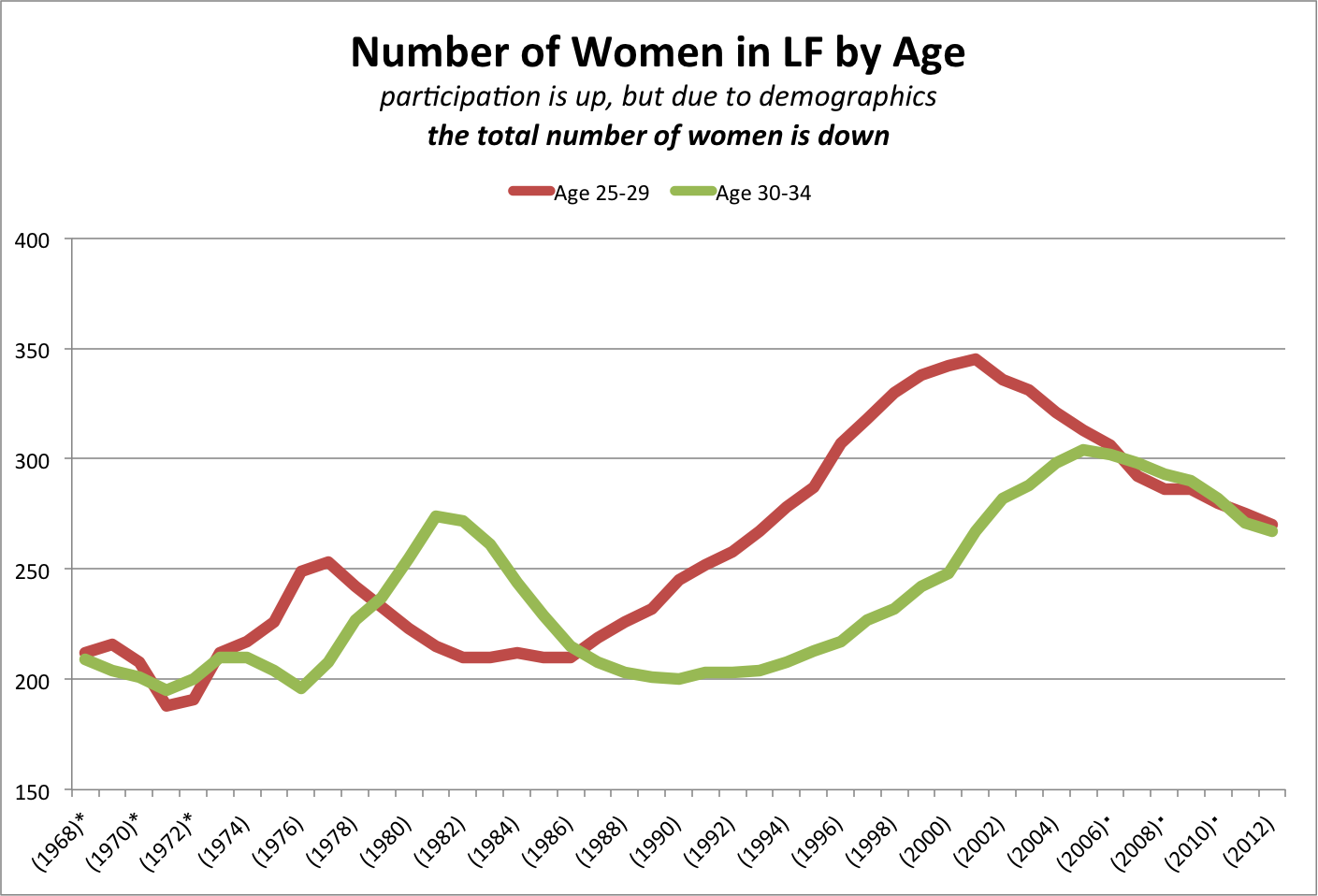
ImageA concurrent set of posts on the NBR Japan Forum is on the role of women in the labor force. At younger ages, the shift towards greater participation is dramatic, a 30 percentage point jump among 25-29 year olds. Participation for women age 30-34 is following in parallel, with about a 13 year lag:
ImageHowever, this is less economically meaningful than at first glance. Women are not going to be able to save Japan from its demographic challenges. Of course it is these very same women who are not having lots of children. But more to the point, these young women are now the only daughters of an already smaller generation of women.
So even a continued increase in women pursuing careers — already apparent among younger women — will only have a modest impact on the shrinking of the labor force. There are simply too few in these age brackets, and the number is falling yearly. Hence despite the rise in participation, the total number continues to decline:
Policy changes could smooth things, and from a microeconomic perspective (and a lifestyle perspective) could bring many benefits, particularly to women. [For an amusing portrayal of the challenge of a stay-at-home father, albeit in a US context, see Kim Stanley Robinson's Forty Signs of Rain.] But from a macroeconomic perspective it's too late for less male-centered policies around the workplace and the home to make a difference.

For the Japanese auto industry – by which I mean the industry located in Japan – this has strong implications. First, this is one of the underlying changes reflected in a set of graphs I posted on the future of the auto industry in Japan: firms hoping to sell cars face a shrinking market. It also means that recruiting workers will be harder. In Japan (unlike in China and India) families do not engage in sex selection (aborting girls), and the change in the number of young men in the labor force is likewise declining. (Indeed, because the participation rate for men has long been near 100%, the drop is more rapid as there has been no offsetting rise in the proportion of men working.)

This shows up too in technical fields; the number of engineers is down 15% from peak and casual observation (academic 2006-7 at Chiba University, a strong engineering school) is that many of those in technical fields are international students. Unless the auto industry (by which I mean suppliers, who generate two-thirds of employment) globalize, they will cease to be players, lacking the engineering clout to stay in the game. And if the unsuccessful efforts of my son (as a TEFL-certified teacher) to find an English teaching job in Japan are at all representative, young Japanese are not learning English. Meanwhile, of course, Honda and Toyota already employ 1,000 or more at their technical centers in the US. As businesses, they are positioning themselves to draw upon a global pool of engineering talent. That however does not help the Japanese industry.

Saturday, August 10, 2013

The Decline of the Japanese Auto Industry

Here are three graphs, pulled from a talk I gave at UMTRI in the spring. The Japanese auto industry – that is, manufacturing and retail inside Japan – faces permanent decline.

Two trends interact. First, due to demographics Japan's population is in decline, and so is the number of licensed drivers. I don't have statistics on the latter, but I have used Census data and population projections to calculate the potential number of licensed drivers. (In Japan you can't get a license as young as in the US, and after age 70 it becomes increasingly hard to get your license renewed.)

Second, the vehicle mix is unfavorable. From the production standpoint, exports are important, but the data show that the market isn't increasing, has more low-value vehicles and is very volatile. The third graph is the domestic parc, which is what matters for dealers. Here the story is even worse, while full-sized cars rose in share along with incomes, that process has ended. Instead what we see is a decline in mid-size car sales (compacts in the US context) and their replacement by "kei" minicars.

Here are implications, as I see them.

  1. Over time dealers will face extraordinary pressure. That will be accentuated by the geographic aspect of population decline, because population will fall more and age faster in rural areas where car ownership is highest. Rural areas are already distinctly older than the major urban areas (Tokyo-Yokohama-Kawasaki-Chiba, Osaka-Kyoto-Kobe, Nagoya, Hiroshima, Fukuoka-Kita Kyushu, and Sapporo). Their potential market is literally dying off. Dealerships in Japan are also unable to sell across prefectural boundaries, so better-run dealerships can't use the internet to extend their geographic market to offset local decline.
  2. Manufacturers will face a smaller market. They have a large number of distribution channels – not including trucks, Toyota has six channels: Daihatsu, Netz, Corolla, Toyopet, Toyota and Lexus, with lineups that overlap and cannibalize each other. (Dealerships are also multi-point, with sales points each trying to buy business from other parts of the same dealership, while the strong players in used cars are independents such as Gulliver.) Rationalizing production and model mix and distribution will be traumatic, as we've seen with the efforts of GM, Ford and Chrysler in dropping multiple brands.
  3. Suppliers will have an even harder time. Small Japanese suppliers were slow to internationalize. Even worse, when I've visited suppliers in Japan for engineering presentations – and in sharp contrast to similar visits in the US and France – I've been the only non-Japanese in the room. That hurts in two ways.
    • First, there just aren't that many would-be engineers graduating from Japanese universities. Without international staff they simply won't be able to stay in the game. Honda and Toyota have huge engineering operations in the US that can handle the entire vehicle development process. As far as I can tell, that's not the case with most Japanese-headquartered suppliers.
    • Second, in order to serve their customers on a global basis, suppliers need to have the same global capability. Some will finesse that by being acquired by foreign firms, and thereby globalize their engineering. Others will prove unable to build a global engineering and manufacturing presence because they've been slow to delegate decision-making and build capabilities and staffing outside Japan. They will steadily lose market share to firms with HQs outside Japan. Indeed, my scanning of industry news (in English, Japanese and [less frequently] German) supports that. Toyota is turning more and more to the big US/Europe based global suppliers, because their own "keiretsu" suppliers can't support Toyota's global footprint.
    • Now this is a third bullet, but is speculative so I won't claim it as a 3rd point. My belief is that because of the two factors above Japanese suppliers lag in technology. Casual empiricism turns to the body of finalists in the Automotive News PACE competition, who are chosen on the basis of successful innovation. Japanese firms are largely absent. [Mea culpa: the competition is entering its 20th year, and I've been a judge since the start.] Not having a truly global mindset, not having the bulk of engineers in Japan able to use English as a working language, means that Japanese suppliers are behind the eight ball in technology. Sometimes it's better to be a bit behind where you can learn from other's mistakes and simply not invest spend money on "advanced concept" R&D that leads to dead ends, the "bleading edge" thing. OEMs also want second sources, so even firms that have reasonable intellectual property know they won't have a monopoly. Still, my judgement is that being second source is less profitable. And being second-source based on production in Japan is a losing proposition.
  4. Japan, as a geographic entity, is already a shrinking part of the global industry. Of course the growth of the BRICs and ASEAN means the same is true of the Euro zone and of NAFTA. My belief is that slow internationalization will accentuate the impact of a shrinking domestic market. That's particularly good new for non-"Japan" suppliers.

In the 1980s the US industry feared that domestic firms would disappear under the onslaught of Japanese "keiretsu" suppliers. That's not what we see if we look at the top 100 suppliers today.

Sunday, April 21, 2013

Costs in the Japanese auto industry


...it's not just OEMs...
Monday I was at the award ceremony for the Automotive News PACE Supplier of the Year competition, for which I've been a judge for the past 19 years; more on that in a later post. On Friday (19 April) I spoke on the Japanese auto industry at an UMTRI conference in Ann Arbor, Michigan. One data point was an overview of the industry; since I begin a new (4-week) term tomorrow (22 April), let me elaborate as indirect class preparation.
The auto industry is not just OEMs, but encompasses dealers and parts suppliers. For Japan, the Economic Census provides an overview of employment of various subdivisions. As in the US, the downstream industry is the largest source of employment. (Note I'm puzzled by the large level of employment at wholesalers; I have no answer.)
Automotive
Assembly
Vehicle
Bodies
Automotive
Parts
Establishments
2006512018,799
2007662108,979
2008672218,921
2009721987,996
2010721707,812
Employment
2006176,66239,661633,297
2007182,99318,842693,322
2008182,70718,503664,257
2009166,47915,513604,644
2010161,15813,402612,193
Annual per worker cash compensation, ¥ million
20067.476.655.13
20077.325.055.25
20087.574.895.47
20096.924.734.92
20107.084.595.10
500+ workers7.114.776.39
Source: Census of Manufactures (工業統計表). Wages are cash compensation divided by employment in establishments
Within manufacturing, the parts sector is the largest by about a factor of three. That's consistent with the US, where Thomas Klier and James Rubenstein found about a 3:1 ratio (Who Really Made Your Car? Restructuring and Geographic Change in the Auto Industry, Upjohn Institute Press, 2008). Now Census data represent classifications by those reporting, so miss the full count. In addition, I didn't include categories (e.g., piston rings) that aren't reported under "autos"; Klier and Rubenstein work with a much more comprehensive set of data. Hence the table at right underreports parts employment.
Finally, I include very rough data on compensation; mandatory benefits add at least another 20%. These data, alongside the employment data, provide a sense of the sharp downturn in 2009-2010, under the impact of the Lehman Shock (as it's called in Japanese). Reflecting lower bonuses (in larger firms the norm is 4.5 months or more pay) and cuts to overtime, compensation fell sharply in those years. I also give a row for cash compensation restricted to the largest size establishments; such locations would in almost all cases be unionized (though contingent workers – contract and part-time employees – would not normally be members and would receive lower pay and benefits).
Now as I write this the exchange rate is ¥99.8/US$1.00, or ¥1 is equivalent to a penny at market exchange rates. The average parts worker in a larger establishment, which account for 2/3rds of output, is thus about $64,000. Add in mandatory benefits and that rises to $76,000. Even at the April 21st exchange rate, that is far higher than the US; at the ¥80 level of last year, that would have been ¥95,000. While this would include engineers, at least if they were located in a manufacturing facility, it is a tidy sum. And it has obvious implications: even if the average worker is more productive than their US equivalent, Japanese workers have (on average) priced themselves out of the global market.
For recent data on the US industry, see the Bureau of Labor Statistics auto industry page: http://www.bls.gov/iag/tgs/iagauto.htm
...Mike Smitka...

Friday, December 7, 2012

Honda as Japan's Exemplar


...Make where you sell, and that's not Japan...
For a while the impact on the auto industry of 3/11 – the earthquake and tsunami – and then the Thai flood garnered headlines. Lately the headlines in Japan have been politics, politics, and more politics. First there was the US election and the leadership transition in China – Japan's #2 and #1 trading partners. Then there are the upcoming elections in Japan and Korea. These have embroiled the auto industry, too, because of the attempt of various parties in China and Japan to wave the nationalist flag, with much of the fallout hitting bilateral Japan-China auto trade. All this has pushed more mundane news – the transition of the domestic Japanese auto industry – out of the headlines.
So here are two snippets, both using Honda as a foil, though these are more general issues.
First, there's the story – Alan Ohnsman at Bloomberg – that Honda will become a net exporter from the US. Why? – because they're ceasing Accord production in Japan. Of course Nissan is already bringing in the March from its plant in Thailand; Mitsubishi has also begun imports from there. But the yen is cutting into the attractiveness of production in Japan, while the domestic market is small: make where you sell, and that's not Japan.
Second, Honda has now moved into second place in sales for January-November 2012, with 701K units. Meanwhile Nissan, the one-time national champion, ranks fifth. (In third and fourth are Daihatsu and Suzuki; Toyota dominates with 1.55 million units, over twice Honda's level.)
What though is Honda selling? It turns out their success -- and that of Daihatsu [a Toyota subsidiary] and Suzuki -- is due to the growth of the "kei" (minicar) segment, vehicles with engines 360cc or smaller. In the full-size segment Honda is a distant 4th, more-or-less tied with Mitsubishi (29K vs 27K units) but far behind Nissan and Toyota. Indeed, in that segment Honda remains behind the importers BMW and Mercedes (at 32,000 and 33,000, respectively). But in compact cars they were second only to Toyota, and Honda sold enough "kei" to move them to the #2 position.

Passenger Cars


Standard
Small
Mini
Total
Trucks
Buses
Grand Total
Toyota
719,229
700,743
30,549
1,450,521
138,574

1,592,957
Honda
28,598
376,402
264,876
669,876
30,531
-
700,407
Nissan
186,042
224,609
117,382
528,033
91,317
1,460
620,810
Daihatsu
175
2,605
514,912
517,692
117,783
-
635,475
Suzuki
2,469
80,790
416,705
499,964
132,866
-
632,830
Mazda
81,212
61,204
39,253
181,669
24,305
-
205,974
Subaru
92,821
3,957
31,144
127,922
35,623
-
163,545
Mitsubishi
26,534
28,652
45,156
100,342
31,679
-
132,021
Others
181,382
30,867
19
212,268
1,804
64
214,136
TOTAL
1,217,756
1,396,773
1,349,335
3,963,864
663,013
10,399
4,637,276
Now domestic sales – cars, trucks and buses – peaked in 1996 at 7.1 mil units; in 2012, the level will be about 5.4 million units, down almost 25% despite the rebound from the depressed levels of 2011. So no one is doing well, and population aging means a declining number of licensed drivers. Things will not improve. But the mix is becoming bimodal, too. Full-sized cars are fine, quite possibly hitting a new peak of 1.5 million units (triple sales in 1990, during Japan's bubble). The shift is from compact cars to minicars. The former peaked in 1990 at 3.8 million units; 2012 will see sales of 1.6 million units. At the same time, minicars will hit 1.6 million units, up from 0.8 million in 1990. The market is thus split about 1/3rd each, but the shift is one that leaves a less rich product mix.

Full
(share)
Compact
(share)
Mini
(share)
Cars Total
Trucks
1990
467,490
(9%)
3,839,221
(75%)
795,948
(16%)
5,102,659 
3,639,909 
1995
889,260
(20%)
2,654,291
(60%)
900,355
(20%)
4,443,906 
2,403,825 
2000
770,220
(18%)
2,208,387
(52%)
1,281,265
(30%)
4,259,872 
1,686,599 
2005
1,271,349
(27%)
2,089,992
(44%)
1,387,068
(29%)
4,748,409 
1,085,904 
2012 - Nov
1,318,462
(31%)
1,509,829
(35%)
1,459,996
(34%)
4,288,287 
395,377 
...mike smitka...

Thursday, May 24, 2012

Reverse Import Deja Vu?

...a strong yen should boost exports to Japan...
In 1992 I wrote a paper about Japanese car imports, later picked up by the Economist, in Japanese by Toyo Keizai (東洋経済) and by the MIT International Motor Vehicle Program about the growth of Japanese car imports. Ah, but what news was in that? Well, I was writing about "reverse" imports by Japanese of their cars from the US to Japan, alongside the sales of German firms, the only foreign companies to set up proper dealership networks and import processing infrastructure. The recent strength of the yen against the US dollar and particularly against the Euro, made me wonder if we will see a return to that era.
A headline in the May 24th Sankei Shinbun web site thus caught my eye: Mercedes-Benz will sell the "Smart for Two" for ¥1.59 million (US$19,992; €15,950), about a 14% reduction in price. Other forthcoming models of M-B and BMW will likewise carry lower sticker prices or add a lot of options without raising the price. Now the article doesn't make it clear whether the base is appropriate -- it uses year-on-year comparisons, and in general spring 2011 was not a normal time. Still, it cites rises of 37% for M-B and 27% for BMW.
I've only glanced quickly through recent data: given the volatility of the global economy in general, and the post-3/11 economy of Japan in particular, I was expecting to find the data too noisy to interpret. That's not the case.
First, overall imports are at the highest level in the years for which I have (FY1999 to present), even though at 4.0 million cars FY2011 sales are 10% below their mid-2000s level (and 20% below the 5.1 million unit sales peak at the top of Japan's bubble in 1990).
Second, while the German firms are doing OK, both BMW and Mercedes are down from 2007 and the onset of the global recession; only VW and Audi show signs of a sustained increase. What really is driving the increase is Nissan, which now accounts for about 17% of imports or 50,000 units. This is surely consequent to their moving the production of certain vehicles (such as the March) entirely out of Japan.
Still, total imports of 295,000 units remain rather short of the 393,000 level of 1996. While the Japanese media may be full of hand-wringing about the impact of the yen, the evidence so far is modest, when looked at through the lens of vehicle imports. Realistically, it's probably too soon to tell; vehicle sales strategies are penciled in a couple years in advance. We aren't seeing "reverse imports" of Japanese-brand cars from the US -- yet. So from that perspective we're also not back in 1996, when 85,000 Toyotas and Hondas went westward across the Pacific. But it is worth watching.
Source: 「159万円のベンツ 円高追い風、価格抑え輸入車加速」 which freely translated says "Fanned on by the strong yen, a Benz at ¥1.59 million will accelerate imports." From sankei.jp.msn.com of 25 May 2012.
...Mike Smitka...

Friday, August 7, 2009

Japan's Headlines: China not Clunkers

Mike Smitka

The top headline in the Nikkei today (Aug 7th) was neither their recession, nor their pending general election (and the potential change of government). It was July car sales in China, up 64% from from 2008 to roughly 1.1 million units. That's above the clunker-driven 1.0 million level in the US, and (as the percentage increase suggests) out of synch with sales doldrums during the past couple summers.
Part of the reason is that, despite the American perception of China as an economy dominated by exports, it's a country the size of the continental US, and that huge domestic expanse is peopled by 1.3 billion would-be consumers. The Chinese government is determined that they will be consumers. To make that happen, the government is providing plenty of domestic stimulus, unhindered (at least in comparative terms) by domestic banking problems, and with little of the pointless tax cuts and other fluff that bolstered the price tag of the "stimulus" package passed in the US. The ongoing construction of a national highway system provides plenty of room to speed things up (reversing the policy stance of a year ago, when the fear was inflation).
There are also vehicle-specific policies with bigger environmental implications than the US program that gets rid of a few seldom-driven1 "clunkers." Their tax breaks and and scrappage incentives (that include provisions to help rid rural roads of smoke-belching 3-wheelers), was implemented in a timely manner in January 2009. The focus is small vehicles, those with under 1600cc engines, with no loopholes to subsidize the purchase of trucks (unlike the US "clunkers" program). And if you visit Shanghai or Suzhou, while you'll find the roads filled with scooters and motorized bikes, the noise level is a fraction of what it used to be: they're electric, driven by batteries. The garages of condos include outlets to plug them in at night, enough to power the daily commute. But diesel fuel in China is still sulfur-laden, so the next-best alternative, a clean-diesel powered vehicle, is not yet an option there -- as was the case until two years ago in the US. So China can't (yet) follow the European option of small, clean and very-long-lived diesel powered cars.
Now the China market is profitable for the moment, and important to global firms. GM has actually shifted its international operations HQ to Shanghai, anticipating its sales there to top 1 million units in the near future; VW already sells over 1.0 million units a year. Accordingly everyone is pouring on capacity and dealers.
This may be a "bubble" of sorts. Already the shift towards smaller vehicles makes it less of a gold mine than a year ago on a per-vehicle basis. Meanwhile, the number of players is mind-boggling: not only are all of the major international players in the market (VW and GM have the top two spots) but there are still 80 local players. Yes, 80 -- because local governments support their "favorite son" firms. If you visit China, watch how the make of taxis varies as you move from city to city. The government is pushing for consolidation, and a couple of the bigger players have bought up a couple small ones. Others have quietly exited. But consolidation has been policy for years and years, and still there are 80 firms! Unless push comes to shove, Beijing has all too little clout at the local level, and this is just one example.
Lots of players ultimately means little profit. GM, Toyota and their rivals are jointly placing a big bet that that does not happen until they've been able to recoup their investment. However, that's a game of "chicken" and at the moment no one wants to blink and ease off on the throttle. I smell a bloodbath in the making, red ink puddled all over balance sheets. That may be 3 years away, but it will happen.
Meanwhile lots of incumbents remain due to (local) government largesse. A couple will turn out to have been well run and innovative, though at present they are still woefully lacking in engineering sophistication. In the background Beijing -- not the locals -- is making a big push towards electric vehicles; ditto battery technology. So a few local firms are likely to focus on electric vehicles (not nightmarishly complex hybrids), and in a market where drivers don't expect to go hundreds of kilometers at a stretch, there will be a local market (unlike in the US). The transition in drivetrain technologies may allow a couple global players to emerge out of the current plethora of small, high-cost producers.
Note that this has strong parallels with the Japanese case. There government policy also pushed for consolidation, and it also failed to accomplish that. Now the early post-WWII market did have about 30 players, and without local government support [Japan's is not a decentralized political system] or other deep pockets half of them soon exited; Toyota and Nissan both picked up with an extra factory or two in the process. The bottom line however was a market with a dozen firms, no dominant firm or even a "Big Three" that could mute competition. In Japan, it was improve efficiency or fail, and in the end that gave birth to Honda and Toyota.2 Japan's auto industry succeeded because industrial policy failed; the same, I suspect, will prove the case in China.3
Notes
1. Unfortunately the mandatory "CARS" survey that is part of the US "clunkers" program doesn't ask how many vehicles were owned. It does ask how many miles were driven the previous year -- as far as I can tell, no data from that question are yet available. Not surprising: most dealers haven't been able to get their "clunker" deals approved, much less gotten a check.
2. There are of course other Japanese firms, but only Honda, Toyota and Suzuki remain autonomous. Nissan is controlled by Renault, Mazda is de facto controlled by Ford, Fuso is owned by Daimler, Nissan Diesel by Volvo Truck, Toyota has purchased Hino and Daihatsu outright and has a large stake in Subaru/Fuji Heavy and Isuzu, and MMC has survived through the inexplicable largesse of its creditors and of Mitsubishi Heavy Industries.
3. I have only cursory knowledge of India. In contrast, I began studying about China in 1971, and while I ultimately became a Japan expert (more practical at the time), I've followed (and taught a course on) the Chinese economy for over 20 years, and have visited the country repeatedly.