Mike Smitka
Thursday, August 28, 2014
Does Car Racing Make Cents?
Here is a post that draws upon questions posed by students that appears on the Economics 244 Auto Industry blog. However, instead of posting it in full here, I encourage you to go to it on The Truth About Cars item Does Racing Make Cents?, in part for the occasionally thoughtful comments that appear on that site.

Wednesday, August 20, 2014
Interest rates, inflation and growth
I go through US data periodically for a weekly radio show on W3Z - WREL in Lexington, Virginia. Unfortunately they don't stream their locally-produced content, probably because most of what they broadcast is syndicated and they aren't licensed to do so.
I've talked in recent weeks about the low returns available on savings. Let me trace that logic in more detail. In the end, I'll tie this to the discussion going on in economics circles about secular stagnation. (Since this is a blog, here's a link to VoxEU, which has just released a free eBook with essays by 19 economists, arguing the empirical strengths, weaknesses and implications of "staganation.")
Long-term rates are generally down since December: 30-year bonds fell from 4.0% to 3.2% and 20-year bonds from 3.0% to 2.4%. Those are drops of 0.8 percentage points and 0.6 percentage points, respectively. (Meanwhile-year rates are flat at 1.6%.) That is not necessarily good news, as it means that the serious money crowd think that growth will be weak for years to come.
Let's look at the numbers over time and see what they imply. If you're an investor, you can buy a 1-year bond today and another 1-year bond a year from now. Or you can buy a 2-year-bond today. Since there are lots of players in this market trading minute-by-minute, those two returns ought to be comparable. Here are calculations of future rates consistent with today's bond prices. (There are other corrections, such as for risk, but I don't think that changes my results in a qualitative manner.)
The first column is actual rates. The second column are rates in the respective years that are consistent with the actual rates. The third column is the year, and the final column is the implied 1-year bond rate that year consistent with today's rates. As you can see below, when I do these arbitrage calculations, we don't get "normal" 3+% interest rates until 2019. (In fact, over the period Jan 1990-Dec 2007 one-year interest rates averaged 4.5%) In other words, we will have had 10 years of well-below-normal interest rates.
The total return after (say) 3 years of buying 1-year-bonds 3 years in a row should equal the return on a 3-year-bond. In algebra, we have (1+i3 yr)3 = (1+iyr 1)*(1+iyr 2)*(1+iyr 3). Excel lets you find the future rates consistent with todays rates; I used rates in 0.25 percentage point (25 basis point) increments to get close.

| Maturity | Interest Rate Aug 19, 2014 | Year | Implied 1-year bond rate | |
| 1 year | 0.11% | 2014 | 0.11% (actual) | |
| 2 years | 0.46% | 2015 | 0.75% | |
| 3 years | 0.90% | 2016 | 1.75% | |
| 4 years | 1.1% (implied) | 2017 | 2.00% | |
| 5 years | 1.59% | 2018 | 2.00% | |
| 2019 | 3.75% | |||
| 7 years | 2.05% | 2020 | 4.00% | |
| 2021 | 3.25% | |||
| 2022 | 3.25% | |||
| 10 years | 2.40% | 2023 | 3.25% |
In the background 3 components are operating::
- Growth will remain low. Unfortunately, the 2019 date is consistent with my calculations of when labor markets return to normal, based on jobs growth versus population growth, corrected for baby boomer retirement, updates of which I post here from time to time.
- We will not have inflation in the foreseeable future. None. (Remember, short-term interest rates should be approximately the growth rate plus the inflation rate.) Yes, there's lots of noise from gold bugs. There are the "old dog" monetarists (those who blindly apply a single, simple-minded monetarist equation, as fitted to data from the 1950s). They play with a few billion dollars. In contrast, the real players, pension and insurance fund managers, mutual fund managers and the Saudis and Chinese have invested a few trillion dollars on the belief that there won't be inflation. I believe money talks.
- Stock prices will remain high and returns low. Low growth means that profits won't rise much, while low interest rates mean that stocks will still look attractive relative to bonds and bank accounts.
Now slow but steady isn't bad, unless you're job-hunting. But low interest rates impose a risk, because interest rates that are near zero can't be pushed down. In other words, as we've observed these past several years, monetary policy has no power, and aggressive "quantitative easing" only a little. If we have another recession – there are lots of scenarios in which something goes wrong over the next 5 years – then we're powerless to do anything, unless we can engage in fiscal stimulus. Will Congress be prepared to act? I fear not.
But let me return to stock prices: Robert Shiller, the Nobel laureate who discussed the housing while it was developing and predicted its collapse, argues that stocks are overpriced (see here on MarketWatch). If growth will indeed remain low, however, interest rates will stay low, and stock prices high by historic norms. That would also make sense from another direction: the returns to buying stocks were unusually profitable for decades. As savers adapt to that and hold more stocks, prices should be high – but then not rise further. So either way – overprice or not – don't look to buying stocks as a reliable way to make money. And certainly don't believe anyone who tells you they can beat the market, or generate good returns. The best you can aim for are comparable returns, and those returns are low.
Finally, we have a reality check in the most recent consumer price data, released yesterday (August 19th). The headline number remains 2.0% and the rate excluding the volatile components of food and energy is at 1.9%. The biggest rises at the detailed level remain medical commodities at 3.0% and medical services at 2.5%. (Actually, these have fallen a bit.)
Oh, and since this is an auto blog, new car prices were up +0.3% in July, but bounce around quite a bit. Over the last 12 months there were up 0.2%, so well below average inflation. The same is true of used car prices, up 0.2% over the past year. However, they have been falling over past few months, and Tom Kontos, the Chief Economist at Adesa, one of the two big auto auction companies, thinks they'll continue to fall: the normalization of sales and leasing over the past few years is leading to a rise in the supply of off-lease vehicles and trade-ins. He doesn't see demand rising so as to offset that. That's consistent with my above analysis of the economy as a whole.
Tuesday, August 19, 2014
Who is Number One?
Auto sales are not the only measure to assess an auto OEM's relative health. This piece from the Detroit Bureau lays it out:
- GM slid to third when it comes to units sold for the first half of 2014. And focusing on just the most recent quarter, the Detroit maker fell to fourth when it comes to gross revenues.
- GM reported gross sales of $39 billion for the April to June quarter, noted Autoline: Detroit Editor John McElroy, putting it well behind Germany’s multi-brand Volkswagen AG, at $68 billion. That was well ahead of even the industry’s leader from a unit sales standpoint, Toyota, which managed a still-hefty $62 billion in revenues.
- The big surprise was Daimler AG, which managed to nudge past GM with $42 billion in second-quarter revenues. GM, in turn, managed to squeak past the Euro-Asian Renault-Nissan Alliance by just $100 million.
- Ford Motor Co. delivered $37 million in revenue, with fast-growing Korean siblings, Hyundai-Kia reporting $33 billion. The newly merged Fiat Chrysler had combined revenues of $31 billion. Rounding out the list of major global plays, Honda revenues came in at $29 billion, with BMW in the industry’s 10th spot at $26 billion.
Thursday, August 7, 2014
Auto Finance Sub Prime Bubble?
I don't think so. For some reason, the New York times jumped on an Equifax report, cherry picked data to suit a sensationalistic agenda, and published the piece on Dealbook (link). Many have weighed in since, including myself – see below! Other examples are Marketwatch and a NYT Op-Ed
Written for Auto Finance News
By David Ruggles
A recent report from Equifax Inc., which noted that originations and total outstanding balances for subprime auto loans have hit recent highs, triggered an alarmist article on subprime lending in The New York Times. In the July 19 piece, authors Jessica Silver-Greenburg and Michael Corkery cited anecdotes that leave the impression that fraudulent practices are widespread. They castigate the “high” interest rates on subprime loans without mentioning the high rate and expense of default and repossession. Repos can reach a third of originations, and collection practices ― which are expensive to begin with ― are a challenge on these loans.
Through April, 2.6 million subprime loans were originated, representing 32% of all auto loan originations, according to Equifax. The outstanding balance of those subprime loans totaled $46.2 billion, an eight-year high. Equifax defines “subprime” as loans to customers with credit scores of 640 or below. As a matter of record, though, in some circles, a loan is deemed subprime when the credit score drops to 580.
The American Financial Services Association and other industry professionals have since weighed in on the NYT article, noting that it enflames already-riled regulators. And Derek Kreindler, managing editor of TheTruthAboutCars.com blog, writes: “Don’t expect that 32% figure to let up anytime soon. The glut of credit available for auto financing ― driven by securitized subprime auto loans being sold as investment-grade instruments ― is going to keep the auto financing business alive and kicking for the foreseeable future.”
I have seen many articles trumpeting the danger of the expansion of subprime without proper context. It is one thing to have data, but quite another to interpret it properly. In the Equifax report, Deputy Chief Economist Dennis Carlson called the increase in subprime lending “good news,” adding that “a fully functioning second-chance market is essential for a healthy economy.”
I would be pleased if people would stop acting like subprime auto financing had a damn thing to do with the global economic meltdown in 2008. It didn’t. Subprime auto financing is nothing like the subprime home lending issues of the past decade, and $46 billion of total outstanding balances on all subprime loans is miniscule compared with the size of the overall economy and a drop in the bucket compared with the mortgage market.
Meanwhile, the ratio of subprime auto originations, including the buy-here, pay-here sector, has hovered around the 30%-to-35% mark for more than a decade. After all, more than a third of the population has a credit score below 640. Kind of makes sense, right? People need cars, and those originations include new and used loans, although they are mostly used.
To be clear, despite the sky-is-falling tone of the NYT piece, Equifax said “serious” delinquencies of 60-plus days remained near all-time lows, and represented less than 1% of total outstanding balances.
A quick call to Melinda Zabritski, director of auto finance at credit bureau Experian, revealed the following: First, the Great Recession spurred the average credit score of U.S. consumers to take the hit one would intuitively expect. Second, when credit dried up, many people ― except for the highest credit score consumers ― turned to BHPH or subprime finance, as one might expect. The stat cited in the NYT article compared subprime originations today with the dark days of the credit crisis, when capital for that kind of lending was completely dried up. Why pick a point in time that is obviously an anomaly, if one is trying to tell a story in real context?
Third, lenders are looking at the near-prime and subprime markets in a search for yield unavailable in the highly competitive prime lending space. Fourth, fast-track credit ― the point at which a dealer can send a contract to a lender without first calling it in for formal approval ― is now 720, up from 690. There are more strict debt-to-income and loan-to-value parameters, as well. Fifth, and perhaps most importantly, millions of consumers have been able to rehabilitate their credit through subprime financing ― and there will be millions more. An accurate portrayal of the Sub Prime market would have at least mentioned this.
There are some who equate subprime auto lending to with mortgages made under the Community Reinvestment Act. Nothing could be further from the truth. CRA mortgages are NOT inherently "Sub Prime." According to the Federal Reserve, CRA mortgages have outperformed the mortgage market overall.
Also, as a matter of record, most of the mortgages that soured during the mortgage crisis were not subprime. Many people with excellent credit walked away from mortgages where they were paying off, for example, $450,000 on a $250,000 home. Yes, their credit score took a hit, and they might have had to get a subprime auto loan to buy a car. It will take some time to repair all the damaged credit. This has played its own part in the slow economic recovery.
Despite the NYT piece, clearly fueled by a desire to create controversy where the facts don’t indicate controversy exists, it’s time for everyone to take a deep breath and keep both feet firmly planted on the ground. There is no subprime bubble.
Saturday, July 26, 2014
Mitsubishi Motors Future: Summer Guest Post #1
This post was written May 12, 2014 by Anton Reed '14 for Economics 244. The Prof edited it and appended comments by others in the class.
I will revise and reblog the best posts of my students over the coming weeks.
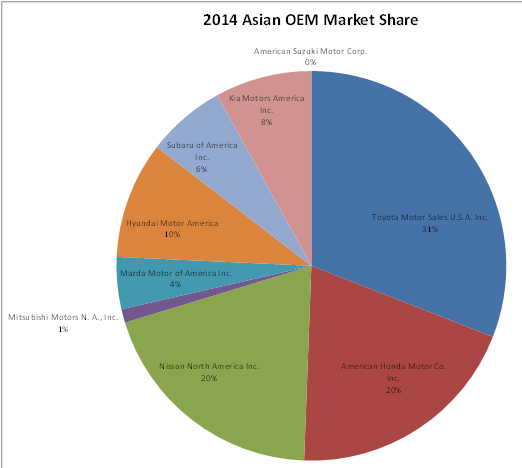
In April, when they released their FY2013 annual results, MMC (Mitsubishi Motors Corp) reported record profits. Don't get too excited.
Mitsubishi Motors' North American operations are struggling; MMC sells far less than any other Asian car company in North America. The next smallest, Mazda, sold almost three and a half times as many vehicles in April 2014. Only six firms sold fewer cars, and of those only Volvo is not a niche luxury marque. (The other five, in decline order of sales, are Jaguar/Land-Rover, Porsche, Tesla, Maserati and Ferrari.)
There are positive signs, with April sales up 46.6% over 2013 and year to date sales up 29%. Only Maserati had a larger increase, but they sold 753 vehicles last year, so that shift represents only a few additional cars. On the other hand, among manufacturers building cars for mainstream customers, Mitsubishi sells the least, so its percentage increase likewise represents only a modest absolute change. Nevertheless Mitsubishi has been improving its North American operation, with net sales up 53% from 2012 to 2013.

Such sales however mean that MMC's Illinois plant – begun in 1988 as Diamond-Star during the era when Chrysler was a major shareholder – continues to operate in the red. Whether or not Mitsubishi will be able to mount a comeback from the brink of essentially complete failure in North America will depend heavily on the continued expansion of their share and the overall vehicle market. Summer sales are expected to be substantial enough to grow the car market in 2014 over 2013, but that increase won't be enough to float MMC. Mitsubishi will likely see its sales cannibalized by the other automakers and go the way Suzuki, Isuzu and Daihatsu, Japanese firms that have completely withdrawn from North America.
Sources: www.motorintelligence.com and www.mitsubishicars.com. Sales graph on right added by the Prof.
STUDENT COMMENTS / DiSCUSSION
Louis Ike · I do not see Mitsubishi making much of a resurgence in sales here in North America. The number of dealerships around any one geographic location is much lower than its competitors, and this only mimics the pattern of low sales volume. The cars that Mitsubishi is currently making, to put it simply, do not fit the consumer preferences of the modern North American. In my opinion, Mitsubishi needs a serious rebranding because its public image is one of cheap, ugly, and obsolete vehicles.
Jier Qiu ·
I think an important reason that Mitsubishi is making profit right now is their new Mirage, which is a reliable, affordable, and fuel-friendly vehicle. I am personally very fond of the brand because their good designs. Although it is pretty easy to get an operating profit from cutting backs and fewer newe investments, I still think Mitsu has the potential to compete in light vehicle sector in the future with Mirage as a good start. They also need to deal with their dealership issue in North America.
the prof ·
Isn’t it the weak yen? It was ¥75 per dollar, now it’s ¥101 / US$. That’s a huge benefit to exporters.
Kade Kenlon ·
It would be interesting to know on the pie chart what percentage of the market that the Asian car companies control. Not only would it put the Mitsubishi market share in perspective, but it would tell you what the potential is for Asian cars. The higher the percentage of Asian cars controlling the market, the better chance Mitsubishi has to succeed. Mitsubishi would have a much easier time overtaking another asian car company rather than an American car, mainly because the Asian cars share the same concept, they are meant to be appliances.
the prof ·
At one time "Asian" might have mattered. As Toshi Amino [retired VP Honda Mfg of America] noted at our lunch table in Ohio, the Marysville plant ranked equal or higher in quality on internal audits than Sayama in Japan, but in the early years [1980s] American consumers wanted a “Made in Japan” vehicle.
Now however do consumers even know (much less care!) that MMC is a “Japanese” company? Or that the vehicle was made inside NAFTA, or imported from Japan / Korea / Europe? It’s an empirical question, and the surveys I've seen suggest consumers no longer care about national identity and import status, though "Munroney sticker" legislation mandates manufactures provide those details on the window sticker found on all new cars. See my thoughts on MMC here: Mitsubishi Motors: going, going … gone?
Now however do consumers even know (much less care!) that MMC is a “Japanese” company? Or that the vehicle was made inside NAFTA, or imported from Japan / Korea / Europe? It’s an empirical question, and the surveys I've seen suggest consumers no longer care about national identity and import status, though "Munroney sticker" legislation mandates manufactures provide those details on the window sticker found on all new cars. See my thoughts on MMC here: Mitsubishi Motors: going, going … gone?
Friday, July 11, 2014
Google's Autonomous Car: Don't Drink the Kool-aid
Google's senior executives are busily touting the wonders of autonomous vehicles. There's the technological marvel, at least in the eyes of Silicon Valley. There are the economic benefits - no more congestion, no more accidents. Wonder of wonders! – and great for the Google empire, and for its stock price.
The PR machine is a marvel to behold, and the gullibility of the audience – well, it's Google! Is their part in this really that much of a marvel? Will economic benefits be as great as they claim? Will they even be a player in future vehicle technologies? Their PR machine is not paid to probe such issues, much less point out that alternative technologies may bring almost all of these benefits more quickly and at a very modest cost.
First, the core innovations necessary for an autonomous vehicle are already on the road, the result of decades-long engineering efforts alongside which Google's investment and expertise pale in comparison. Blindspot detection, lane departure warnings, backup "assist" (outside the US that is surely called a safety feature) and adaptive cruise control are all necessary for an autonomous car. Now some of these aren't cheap, but they're falling in price. So we don't have to await an entirely new generation of vehicles to begin reaping the benefits. Crucial to Google's vision is that these are all partial solutions. However, I am not at all convinced that what Google offers will be a sufficiently big increment to offset the additional costs of full autonomy. Nor is it at all obvious that Google will have any role short of autonomy – their presence is not needed for these existing tools.
Second, Google's is not the only approach. In particular, connected vehicle technologies promise most of the benefits at a far lower price point and with a faster rollout. Such systems are inexpensive because they can use the copious computing power already in car, while the hardware consists of inexpensive RFID transponders (though not as inexpensive as the tags retailers use to deter shoplifting). The pieces of such systems are now being tested on the road, with a large test facility – the Michigan Mobility Transformation Center – an artificial cityscape – under construction in Ann Arbor, adjacent to the University of Michigan Transportation Research Institute. Such systems don't require the panoply of sensorts of an autonomous vehicle. Indeed the core components could be sold as an aftermarket item, albeit with lower functionality. Such connectivity could be rolled out in the course of years.
In contrast autonomy will require decades. First "real" vehicles need to be out in sufficient numbers to overcome regulatory fears and start the path to consumer acceptance. I can't see that happening before 2020, given the lead time for vehicle development when new systems are involved. It's not just that the hardware and software have to be integrated into existing vehicles, it's also that test procedures need to be developed for both the hardware and the software. Then production capacity has to be ramped up, while successive generations of vehicles are designed. That's another 10 years. And then the fleet will gradually turn over; with the average age of vehicles now over 11 years, that's another decade for half of all vehicles to be autonomous. We're thus looking at 2040. A combination of aftermarket and designed-in RFID systems could be on every vehicle by 2025, offering varying levels of collision avoidance and traffic flow smoothing.
Google likes to trumpet the elimination of accidents and the end of congestion. Perhaps. However, the restructuring of where people live versus where they work is a process that will take decades; in many cities, particularly in the US, the housing stock is widely dispersed, and so we really won't be able to get rid of all those cars, another claimed benefit of autonomy. Will connected vehicles deliver all of the same benefits? No, at least not initially; any aftermarket device could only offer warnings, nor take over steering and braking. Still, the price point and the time horizon are quite different from the drink Google wants us to imbibe.
Will there be a role for autonomous vehicles? Certainly truck trains are one application, and off-road uses in mining and construction. The Department of Defense is surely a potential customer. Don't look to these to drive Google's stock valuation, or you will have drunk the Kool-aid.
Wednesday, July 9, 2014
Call for Entries: 2014-15 PACE Supplier Innovation Competition
Time for suppliers to apply for the 2014-15PACE COMPETITION! (Links to PACE web site)
Subscribe to:
Posts (Atom)