Last November, General Motors’ IPO set a record for money raised at 20.1 billion dollars. This is all money returned to the taxpayers’ Troubled Asset Relief Program (TARP). The success of the IPO was not only driven by new investors, but also by stockholders and lenders who had been “stiffed” in GM’s Chapter 11 bankruptcy of 2009. The company recently reported its highest quarterly profit in more than a decade, helped by demand for fuel-efficient cars and a big gain from selling its stake in its former auto parts business. The biggest U.S. automaker said Thursday that it earned $3.2 billion, or $1.77 per share, in the first quarter. It was a great start for the year considering the spike in U.S. gasoline prices, a trend that would have sunk the company just a few years ago when it relied on gas-guzzling pickups and SUVs for profits. Earnings will accelerate if U.S. auto sales continue to creep back up toward the 15-million to 17-million vehicle-per-year sales rates the U.S. industry last saw in 2007.
"GM is making a lot of money at ‘depression levels’ of sales. As the market improves it should make even more money." said Dave Cole, chairman emeritus of the Center for Automotive Research.
The U.S. Treasury will remain GM's largest shareholder for now. It will likely take several years to unload the entire stake to keep from diluting its stock price. Taxpayers still own about 33% of GM shares. The stock price will need to rise to about $48.00 for the U.S. government to break even on its follow-on stock sales. At $48 per share, GM would have a market value of more than $90 billion.
Chrysler Corporation paid back more than 7.5 billion in loans to the American and Canadian governments in May. Chrysler had until 2017 to repay the loans, so this was six years ahead of schedule. The company has now paid back most of the loan money that saved it from going under. The government loans were high interest loans, about which Fiat/Chrysler Sergio Marchionne recently opined. Instead of merely complaining about “loan shark rates,” the company did something about it. The high interest on the U.S. Government loans certainly induced Chrysler’s partner FIAT to borrow the money to pay off the bulk of Chrysler’s outstanding government loans. Chrysler raised just over 3 billion through a bond sale and took out 3 billion in lower interest loans to come up with the money to pay back the government loans. This will save more than $300 million a year, according to the company.
The automaker still owes taxpayers about $2 billion. Treasury could get most of that back by selling its remaining 8.6 percent stake in the company, which it was given in exchange for the loans. Chrysler’s IPO has yet to be scheduled but FIAT just announced it is increasing its stake in Chrysler to 51% from the current 46% in advance of the upcoming IPO. As Marchionne recently observed, “The longer we wait, the more it costs,” referring to FIAT’s intention to buy shares from the U.S. Treasury.”
Chrysler’s recent earnings have also been strong, despite a market impacted by high fuel prices and a weak, but recovering, economy. Both companies stand to do extremely well as the economy improves and the SAAR rises to recent historical levels.
Both companies have announced initiatives to increase production and rehire thousands of workers. Chrysler alone has added more than 8,000 jobs since its bankruptcy.
In the meantime, Ford continues to do well in the still recovering economy despite having to bear the weight of interest on debt it accumulated to ride out the economic storm without having to seek taxpayer involvement. Ford has benefited from union concessions it received to maintain parity with its competitors.
The auto industry bailout, financed through the Bush Administration’s TARP program, spared the GM, Chrysler, AND Ford from liquidation and saved hundreds of thousands of manufacturing jobs at those companies and its suppliers.
To add perspective, had either company been forced into liquidation, the cost dropped on the taxpayers in the form of the Federal Pension Benefit Guarantee Fund would have been at least $38 billion. This in addition to the damage that would have been done to the North American industrial base, including military procurement at a time of two wars.
While Americans have been known to pile on “losers,” failures, and those who make mistakes, they love “redemption.” While there are those who refuse to buy a GM or Chrysler vehicle OR buy their stock because they were bailed out by the government, the companies’ strong sales and profit results indicate that, on balance, they are achieving a large measure redemption. The popularity of Chrysler’s “Made in Detroit” advertising campaign is further evidence.
In the meantime, the 2012 election campaign is getting underway and yes, it looks like the bailout of the auto industry could end up being one of many points of debate. One can expect Democrats to replay videos of Republicans who opposed the bailouts ad nausea. Already an ad paid for by the Democratic National Committee recaps positions taken by Mitt Romney, Newt Gingrich, and Tim Pawlenty.
Romney takes a significant hit in the ad. The former Massachusetts governor, whose father was governor of Michigan as well as the top executive at American Motors is being reminded of the hard-lined position he took in a 2008 New York Times Op Ed, “Let Detroit Go Bankrupt.” Yet Romney and others continue to use opposition to the bailouts as a campaign point, advocating a free-market system free of bailouts and subsidies. They maintain that even now it still looks like the bailout came at quite a cost to taxpayers, despite substantial evidence to the contrary. They maintain that allowing the automakers to go into liquidation wouldn’t have been such a terrible thing, which is easy to say since it didn’t happen.
Democratic candidates will point to the relative success of TARP and the auto company bailouts and paint a picture of what would have happened had TARP not been enacted and either company had liquidated.
As politics heats up leading up to the 2012 national elections, expect debate over the auto bailouts to play a major role in determining political winners and losers.
David Ruggles has spent his working life in every phase of the retail side of the auto business, new and used, sales and management, including consulting and training in both the U.S. & Japan. Ruggles has been a dealer for Mercedes-Benz, Chrysler, Dodge, GMC, Ford, Mazda, and Subaru, and has consulted for one of the world’s largest privately owned Toyota dealer groups located in Japan. He blogs at autosandeconomics.blogspot.com and writes regular columns for several publications.
Sunday, June 5, 2011

Wednesday, May 4, 2011
Contango
And other issues not commonly understood by consumers about the world oil market
The higher the price of gas at the pump, the more sensitive consumers are to allegations of oil market price manipulation. Most consumers are unaware exactly how any manipulation takes place, but they can't square the doubling of the price of a gallon of gas when the price of a barrel oil doesn't double, so they are suspicious there is a culprit to be blamed. Oil companies become the bad guys as they report high profits.
Well there IS oil market manipulation by the most major of oil traders. AND it isn't even illegal. But it takes tremendous amounts of capital to manipulate the world market price of oil. For a variety of reasons, the best known energy trader manipulating the world market price of oil is Koch Energy, probably because of the Koch brothers high profile participation in the political process.
So what is "contango?" Contango is the strategy of purchasing large stocks of oil and storing it in offshore supertankers and giant containers, creating a shortage or exacerbating a real or perceived shortage in the market. The trading company then it sits on those supplies until oil prices rise.
Ever wonder how gas prices can be $4.50 per gallon in say July 2008, and then drop to $1.90 when President Obama was inaugurated In January 2009 six months later? Crude oil prices dropped from more than US$145 per barrel in July 2008 to less than US$35 per barrel in December 2008.
When the contango hoarders turn their stocks of oil loose on the market at the peak price, it tends to flood the market with oil, especially when consumers have cut back on consumption due to the high price. At the same time all producers pump and transport like crazy to take advantage of the high price, including those in the oil patch. The end result is a glut and cheap fuel at the pump. And consumers end up with fuel price volatility. U.S. consumers tend to think they are entitled to the "glut" fuel prices, rather than the highest price or even an intermediate price.
For those who recall, the Bass Brothers' play on silver in 1977 and 1978 was a form of contango.
But there is another example of "hoarding" on a much larger scale. OPEC has been hoarding oil for 35 years. In 2011 there are more members of OPEC than in 1973 and world wide consumption has accelerated. Yet, OPEC doesn't produce any more oil today than they did in 1973. OPEC is not in the business of just selling volumes of their finite resource, as much as maximizing the price they get for each barrel. The U.S. produces about a third of its oil domestically. We get another third from Mexico and Canada. The final third comes from OPEC. What is not clear to most Americans is that if we double our domestic production, and eliminate the OPEC purchases, we still have not freed ourselves from the world market price of oil. Why? Because Americans do not own the oil produced here, the oil company that makes the investment to find it and produce it owns the oil. The chances of an oil company selling their oil to the U.S. consumers at less than the world market price is slim and none. Yet, I don't hear a lot of talk about nationalizing the oil companies.
But there is another example of "hoarding" on a much larger scale. OPEC has been hoarding oil for 35 years. In 2011 there are more members of OPEC than in 1973 and world wide consumption has accelerated. Yet, OPEC doesn't produce any more oil today than they did in 1973. OPEC is not in the business of just selling volumes of their finite resource, as much as maximizing the price they get for each barrel. The U.S. produces about a third of its oil domestically. We get another third from Mexico and Canada. The final third comes from OPEC. What is not clear to most Americans is that if we double our domestic production, and eliminate the OPEC purchases, we still have not freed ourselves from the world market price of oil. Why? Because Americans do not own the oil produced here, the oil company that makes the investment to find it and produce it owns the oil. The chances of an oil company selling their oil to the U.S. consumers at less than the world market price is slim and none. Yet, I don't hear a lot of talk about nationalizing the oil companies.
Further, when we increase production, OPEC cuts theirs back a like amount to maintain the supply/demand balance. The graph at the following link shows the production of OPEC over the decades: (graph link)
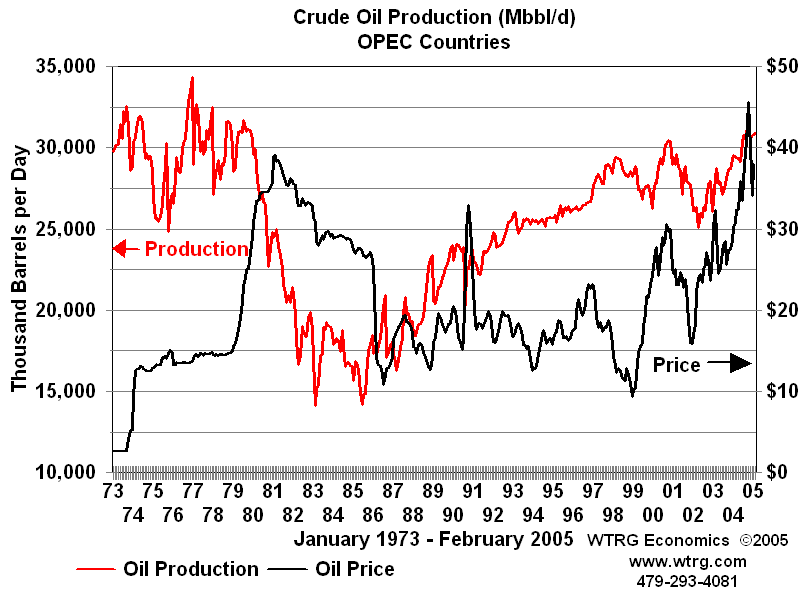
More domestic production WOULD improve our balance of payments situation, but it would quickly eat up our meager oil reserves. The U.S. maximized domestic oil production in 1970 and uses 25% of the world's production while owning less than 5% of known reserves. We ramp up production, OPEC cuts theirs back, and we use up our reserves without saving a dime. So much for “Drill Baby Drill.”
Off shore and ANWR reserves seem like a lot of oil until weighed against U.S. consumption. OPEC sits on 70 - 80 percent of the world's known reserves, to put things in perspective.
There are those who think we are better off to use up others' reserves and keep ours for a rainy day. The Bakken Formation oil shale reserves in the Dakota and Montana ARE huge! Bakken currently produces about 500 million barrels of oil per day.
BUT oil shale development requires large expenditures of water and energy, produces air pollution and carbon emissions and leaves toxic byproducts that endangers the environment, especially the water table. For example, a fully developed Bakken formation could leave the entire Southwestern U. S. with a huge water problem. In addition, the high cost to produce from oil shale in Bakken is only viable when the world price of oil is between $80. and $100. per barrel. Major investment in Bakken on oil shale development has been tentative as investors are afraid OPEC would open their spigots to drive down the price of oil, throwing them into bankruptcy.
While there isn't much we can do about hoarding by OPEC, there have been initiatives to tighten regulations on commodity and derivatives trading. Lobbying against this regulation has been fierce. In fact, the same Commodities and Futures Trading Commission (CFTC) is the same government agency that tried to regulate credit default swaps and collateralized debt obligations on Wall Street. Larry Summers, Alan Greenspan, Robert Rubin and others blocked the efforts to regulate commodities and derivatives by firing the chairman of the CFTC, Brooksley Born, and replacing her with Wendy Gramm. Yes, this is the same Wendy Gramm that was on the board of directors of ENRON when its energy trading speculation and suspect accounting wiped out millions of investors AFTER she had blocked regulation that would have prevented it from happening.
For now, large energy traders continue to benefit from the lack of regulation while U.S. consumers suffer to a greater extent than necessary.
Over his 40 year career David Ruggles has been in every phase of the retail automobile business and has consulted with and done training for hundreds of auto dealers in the U.S. and Japan. He conducted a yearly seminar for one of the world's largest privately owned Toyota dealer groups for eighteen years, and has himself been a dealer for Chrysler, GMC, Mercedes Benz, Ford, Mazda, and Subaru. Author of the Ruggles Report, and a regular contributor to the National Bureau of Asian Research, he blogs at autosandeconomics.com and writes regular columns for several trade publications and The Daily Post online newspaper. He is a member of the International Motor Press Association.
Thursday, April 28, 2011
Cars and Roads
I'm now teaching my annual 4-week-long Spring Term course on the auto industry at Washington and Lee University, Economics 244, which will include one week in Detroit. Ironically, it has left me too busy to blog on the auto industry. So this will be short.
It's very easy in our narrow focus on the manufacturing and distribution of cars to overlook the revolutionary impact that comes from greater mobility. A note on a World Bank project in Laos highlights that. (Here's the link.)
The blog by Victoria Minoian traces the changes the follow from building a road that allows motorized access. Rural farmers can now grow vegetables for town and city markets, and not merely for own consumption. That is, they can earn a cash income. Doctors can access a village otherwise cut off on frequent occasions by high water. Children can get to school &endash; though perhaps by bicycle rather than motorized vehicle. There's little point in building good roads without motorized vehicles; but without roads, vehicles are also of little use. Of course the location of the village from which these examples were drawn reflects that constraint: it was alongside a river (the Mekong, not just a little river). The village wasn't necessary poor by local standards. But while boats and rivers make a difference, roads and motor vehicles make a bigger one.
Mike Smitka
Thursday, April 14, 2011
Long Term Residual Outlook
I have been privileged to discuss residual values and the pre-owned market with a number of industry experts over the years. An thought that was born in a late 2008 discussion over a beer with Matt Traylen, then Chief Economist for Automotive Leasing Guide, has since become full-blown reality.
At the time, the stock market was tanking, new vehicles sales had slowed to a crawl, the auto manufacturers were begging for money before Congress, the acronym TARP had just been coined and the economy and our lives were looking bleak and uncertain.
Most lenders had announced in previous weeks that they were getting out of the leasing business, or dramatically “pulling in their horns.” The asset backed securities market had disappeared, pulled down by the mortgage backed securities market and we were hearing unpleasant terms like “toxic assets.” This reminded me of some earlier dark days in the auto industry when a dealer or leasing company might take particular vehicles to auction and they wouldn’t even draw a single bid, a particularly difficult position when one had a payroll due.
It was easy to understand how a bank holding a lot of “toxic assets,” but little cash, could become a “zombie bank,” a term invented to describe the Japanese banks after their own real estate bubble burst. That is a bank with a “strong” balance sheet but no cash to loan or to return to depositors who arrive “electronically” at the bank to make a withdrawal. Marking these assets to market was not practical because values could not be established as no one would bid on these mortgage backed securities or their “first cousin,” auto loan backed securities. Regardless, “mark to market” would have rendered the U.S. banking system insolvent and caused a complete meltdown. A strong case can be made that the U.S. banking system WAS, in fact, insolvent but for a few accounting entries.
After acknowledging that most of the major players had announced their exit from the leasing business, the collapse of available financing for fleet and daily rentals, and the dramatic drop off in overall new vehicle sales volume, Traylen and I asked, “Where will pre-owned inventory come from down the road?”
While used vehicle sales plunged from a high of about 44 million units in a single year to about 35 million units in 2009, it became apparent that once demand began to trend upward toward historical volumes, there would be an acute shortage of available inventory.
Within a few months, GM and Chrysler went through bankruptcy and Cash for Clunkers plucked another 600,000 potential pre-owned vehicles out of the system and fed them to the crusher. What was really crushed was the Buy Here Pay Here business. What the government called a “clunker,” they call “inventory.”
Today, there is considerable pent up demand for pre-owned vehicles and the banking system has recovered to the point that ready financing is available again. There are still serious issues to be resolved in the economy, not the least of which is high unemployment, but demand is building.
Other than unemployment, the biggest impediment to full economic recovery is the fact that 25% of American mortgages are in negative equity territory. The large numbers of foreclosures have left empty and/or abandoned houses in neighborhoods across the country further depressing home values. Few neighborhoods, regardless of affluence, are immune from this.
Economist Alan Greenspan, past chairman of the Federal Reserve Bank, recently stated that he did not believe the economy could reach full recovery momentum until the real estate market experienced at least a 10% increase in home values. It just is not clear how long it will take for home real estate to become stabilized, let alone regain value. On the other hand, the rebound of the stock market has restored almost 16 trillion dollars of mostly American wealth.
Against this mixed backdrop of economic news and general economic uncertainty, there is much more demand than available pre-owned inventory, which is driving wholesale pre-owned prices ever higher. We see pent up demand in the new vehicle business by the steady increase in sales results.
New vehicle incentives have a considerable impact on pre-owned values. If incentives lower the true transaction price of new vehicles, the value of same make/model pre-owned vehicles drop a commensurate amount.
Restraint of late on the part of auto manufacturers to refrain from over production is keeping dealer inventory levels in line with demand. It is likely that OEM restraint on overproduction and incentives will be ongoing as they have new policies and labor agreements in place. The fact that dealer floor plan arrangements with lenders are much more restrictive than before has also helped maintain this equilibrium. Few dealers have the liberal floor plan arrangements these days that once allowed for the massive stocking of vehicles on behalf of a manufacturer looking to “force the market” with incentives.
But now that financing for leasing has recovered, OEM captive finance arms are focusing on shorter terms to try to create additional supplies of pre-owned inventory. Financing for the daily rental business has allowed rental companies to begin to return to more traditional replacement cycles. The same is true for fleets. But the shortfall that began in 2008 will not be able to be made up in the short term.
So what is the outlook going forward and how will it impact residual values?
Experts say we will continue to experience pre-owned shortages for at least as long as 5 years. Some niches will be more acute in this respect than others, and segment values could change with fuel prices and other issues.
But the tremendous shortfall in pre-owned inventory supply will take years to balance out as demand increases in line with economic recovery. In talking to experts like Tom Webb, Chief Economist for Manheim Auctions, Tom Kontos, Chief Economist for Adesa Auctions, Ricky Beggs, Managing Editor and Vice President for Black Book, Rene Abdalah, Vice President of Residual Value Insurance Group, Eric Ibara, Director of Residual Value consulting at Kelly Blue Book and Traylen who is currently head of M.A.T. Consulting, the consensus is that the shortage will be with us for at least 5 years. Residuals are expecting to stay quite strong!
However, in projecting residual values, there is a somewhat different outlook between Abdalah of RVI and Ibara of KBB and their counterparts at Automotive Leasing Guide. Both companies are convinced that as long as fuel prices increase gradually, American consumers will adapt without drastic short-term consequences. Consumers will tend to buy the largest vehicles they can afford.
Other than “early adopters,” most consumers will only pay a technology premium for “electrics” and hybrids if the government pays it for them through tax credits or other subsidies. When fuel prices suddenly spike, as they did in 2008, fuel economy becomes the consumer’s primary motivator. However, experience shows this is a short-term circumstance.
As we have seen repeatedly, and as recently as the price spikes in 2008, high fuels prices are followed by oil gluts and extreme fuel price declines as oil producers rush oil to market to capitalize on the high market prices, creating over supply. In 2008, the cycle began in April when the price threshold broke $4./gallon. By the time January 2009 arrived, a gallon of regular was $1.90.
So while there may be some price spikes along the way, Ibarra and Abdalah expect the overall fuel price trend will be gradual. As a consequence, manufacturers will have to deal with substantial Corporate Average Fuel Economy (CAFÉ) fines if consumers do not naturally purchase a product mix that lends itself to the auto manufacturers’, and the government’s, CAFE objectives.
In the past we have seen manufacturers prefer to pay significant consumer incentives to move vehicles they need to move to avoid the CAFÉ fines. With CAFÉ requirements at extremely high levels, it is logical to expect the focus of OEM incentives to be on fuel efficient vehicles. The CAFÉ standard for 2016 for cars is 39 mpg and 30 mpg for trucks. This will drive down the values of like make/model pre-owned vehicles. Lessors need to consider this very real possibility looking down the road.
At the same time, manufacturers can be expected to raise the price of larger less fuel efficient vehicles and reduce incentives to try to make more gross profit per unit, while somewhat depressing volume to enhance their CAFÉ calculation. As a consequence, Kelly Blue Book and RVI Group residual projections are higher for “heavies” than ALG’s projections while ALG’s projections are higher for smaller fuel efficient vehicles.
If a cataclysmic event takes place and oil goes to $200. plus per barrel, and stays there, all bets are off anyway.
Lenders, fleet operators, and private capital leasing companies will have to make their own overall residual setting decisions and come to their own conclusion about each size and fuel economy segment. However, there is no doubt that overall residual values will stay historically strong in the years to come as strong demand for pre-owned vehicles overwhelms the available supply.
David Ruggles has spent his career life in every phase of the retail automobile business and has consulted and trained with hundreds of auto dealers in the U.S. and Japan. Ruggles has been a dealer for Chrysler, GMC, Mercedes Benz, Ford, Mazda, and Subaru. Author of the Ruggles Report, and a regular contributor to the National Bureau of Asian Research, he blogs at autosandeconomics.com and writes regular columns for several trade publications and The Daily Post.
David can be reached at ruggles@msn.com and by phone at 312.925.1863
Tuesday, April 5, 2011
Dealers Push Back
Emboldened by recent healthy profits and the prospects of a recovering economy, auto manufacturers are pressuring their surviving dealers, at least the ones that have survived arbitrary terminations and recession, to upgrade their facilities. This, at a time when Dealers are desperately trying to repair their balance sheets and reconstruct relationships with their bankers after a bloody few years of just trying to “hang on.” Dealers have enough problems dealing with recalcitrant banks just to maintain reasonable floor plan lines and capital loans without having to ask for facility renovation money. Perhaps after a few years of recovery and bolstering their balance sheets, Dealers might be in a better position to entertain the idea of facility upgrades. And for the ones who can get financing or have cash, does it or will it make economic sense given current trends?
Manufacturer’s demands and requests are often supported by “focus groups” where consumers are asked what value they put on a dealers facility. Everyone seems to like a nice clean facility. Let’s face it, shiny granite, marble and wood DO make an impression. So do boutique expresso bars, nail salons, shoe shine stations, and other “foo-foo” features. The problem is, as much as consumers like these things, a growing number aren’t willing to pay for them. The consumer thinks the value of their business is the 35K they just paid for a new vehicle, not the $2k the Dealer retains out of which they pay their expenses.
Increasingly, consumers care less and les about fancy facilities as their PC and monitor tend to be their showroom of choice. While a facility on a high traffic piece of property might bring consumers in to take a sales person’s time to answer questions and take a demo drive, the negotiation is much more likely to take place “on line” these days. This IS the “new normal.” This is where high overhead becomes a disadvantage. As one consumer said to a Dealer friend, “I can’t drive your overhead, why would I want to pay for it?” This same Dealer, who shall remain nameless, is being pushed by his manufacturer to erect an elaborate sign to replace the one that existed when that manufacture terminated his franchise. Having regained his franchise through arbitration the OEM just can’t understand that the old sign was “grand fathered” and the new one has to meet CURRENT city code. The sign is a small part in a major push to “encourage” the Dealer to invest more in an already impressive facility. But this is just another day in the life of a dealer.
Dale Pollak, chairman of vAuto, is right when he wrote in a recent article that there is no need for dealers to do warranty and repair work on a high dollar piece of property. Is the added convenience worth the extra overhead?
The retail auto business is trending in such a direction that Dealers need to be more conscious of overhead costs than ever before. Manufacturers need to “get a clue.” If their Dealer can’t compete because of unnecessarily high overhead mandated by the manufacturer, it becomes increasingly difficult to find another investor Dealer for that point.
And as the Internet provides a more efficient market for each new generation of consumers, high cost facilities become even more of an albatross. In other words, expect the current trend away from “in showroom” negotiation to “online” negotiation to accelerate.
Manufacturers and some Dealers seem to ignoring a demographic fact. Consumers my age tend to put a lot of value on relationships, proximity, and convenience. But younger consumers are different. They have never known life without the Internet. They feel empowered by it. They are much more likely to use the “Taj Mahal,” high overhead dealer for information and service and warranty work, but to use the Internet for negotiation. They will travel for the cheapest price. I wish this weren’t so, but it is what it is.
As such, we’re in virgin territory in the retail auto industry. The new “book” is still being written. Manufacturers cling to commonly held dogma, as do many Dealers. But the future will only be loosely based on old models. The day is coming when Dealers will have to bid for a consumer’s business on line!
The pre-owned business will most likely increase in relative profit importance in tomorrow’s dealership. Warranty income will probably continue to dwindle due to the increased quality of vehicles. Financing and after market income is under the scrutiny of Elizabeth Warren and federal bureaucrats.
The future will belong to those Dealers who are prepared for it, and not encumbered by yesterday’s standards.
So when the manufacturer comes calling Dealers may need to learn how to, “Just say NO!”
Written by David Ruggles for Auto Finance News
"Turning Oil Into Salt" book review.
Book Review of "Turning Oil into Salt," a book by Gal Luft and Anne Korin
If you believe in global warming, you believe we need to get off of fossil fuel. If you believe we need to reduce the strategic value of oil, it is a somewhat different calculation. People get these issues confused. Reducing our dependence on fossil fuel is generally considered the province of "Green Liberals," "Al Gore Disciples," "Tree Huggers," "Global Warming Alarmists," etc. That isn’t totally true as evidenced by the video at made by unlikely partners, Newt Gingrich and Nancy Pelosi.
But reducing the strategic value of oil is something everyone should be able to agree on, even for those who are skeptical that a global warming hazard even exists. The following video was made by ex CIA head James Woolsey: http://www.youtube.com/watch?v=3mWeyREivdk
So why are you reading this in an auto publication? Because according to Gal Luft and Anne Korin, the authors of "Turning Oil Into Salt," MORE government intervention into the auto industry is required to reach a solution. Many of us are rolling our eyes at even the thought, but the stakes couldn't be higher. "We ARE engaged in a war against fundamentalist Islam, and we ARE paying for both sides of the war," say the authors.
Today, roughly two-thirds of the world's oil is used for transportation, and most vehicles are able to run on nothing but. Oil's strategic status stems from it=s virtual monopoly over fuel for transportation, which underlies the global economy and our way of life. To understand the implication of an over dependence on a strategic commodity we can look at history. At one time, salt had a virtual monopoly on food preservation. Wars were fought over salt. Finally, Napoleon, who's army "traveled on it's stomach," had had enough and offered a significant sum of money to the person to eliminate his army's reliance on salt. Within a few years, a French chef invented food "canning." After canning, electricity, and refrigeration, salt has lost its strategic status and we no longer go to war over salt.
How can this be accomplished with oil? According to Luft and Korin it only requires Congress to mandate that from a specific date forward, all or most vehicles sold in the U.S. must be manufactured as Aflex fuel@ vehicles, capable of running on gasoline and/or a variety of alcohols and blends. This has already been done in Brazil where 80% of new vehicles purchased in 2008 were flex fuel. The additional cost to produce a flex fuel vehicle is about $100., which includes the cost of premium fuel system components, a fuel sensor and computer chip reprogramming. The first Model T Fords ran on gasoline OR alcohol. There are a variety of alcohol fuels available. Alcohol does not mean just ethanol, and ethanol does not mean just corn, a particularly bad fuel feed stock. Other alcohol based fuels include methanol made from coal and ethanol from almost anything. And speaking of coal, Germany fueled its WW2 war effort with diesel fuel made from coal. A lot of this technology is old, having been rendered unnecessary when we had cheap oil spurting out of the ground.
According to the authors the average vehicle in the U.S. is in service for 16.7 years. Once 15% - 20% of the total vehicles on the road are flex fuel, the market will take over. Refueling infrastructure will develop and additional alcohol production will come to market with coal/methanol probably eclipsing corn as a feed stock, much to the chagrin of Midwestern farmers and Senator Charles Grassley.
Add in additional vehicles operating on compressed natural gas and electricity, plus additional conservation based on increased fuel efficiency “encouraged" by CAFE, and dependency on oil could be reduced 35% in 10 years, the exact amount we import from OPEC. We would also be less dependent on oil in general and all of our oil could be sourced from North America, including Mexico and Canada. There is even a "Drill Baby Drill" component to the Luft/Korin plan, although the U.S. has some disadvantages. It costs OPEC less than a dollar per barrel to lift their oil from the ground, while it costs us almost $10. They have about 78% of the world=s known reserves, but only produce 40% of the world's supply, as they work to maximize the price of each barrel they sell. OPEC produces less now than they did in 1973, despite having more cartel members.
In the meantime, we have less than 5% of known reserves but consume 25% of the world's production. And the lower the American price at the pump, they more we consume and the more pressure we put on the world market price of oil to rise. Unfortunately, we don=t get a discount for our volume purchases.
A bill called the "Open Fuel Standard" (OFS) is pending before both the House and the Senate. Of course, it has been pending for months. The bill ensures that 50% of new vehicles sold in the U.S. with an internal combustion engine would be warranted to run on gasoline, ethanol, or methanol. Diesel vehicles would also be warranted to run on bio-diesel.
In 2009 there were no fewer than 33 Make/Models warranted to run on up to 85% ethanol, but no warranty for methanol. Expanding this to more models and including blends of methanol should be easy. Brazil has done it and at one time, auto manufacturers and oil companies in this country considered using methanol as an octane booster, but chose lead instead.
There are currently 8 million flex fuel vehicles on the road out of 200 million total vehicles but we have not yet reached the critical mass necessary for the market to respond with refueling infrastructure and additional investment in alcohol production. In light of the increased price of fuel at the pump, the Open Fuel Standard bill needs to be rapidly advanced while the issue of high fuel prices is fresh in people’s minds.
Some say the expansion of alcohol fuels and the OFS bill is being held hostage by agribusiness lobbying efforts. along that same line, for some reason, we place a 54 cent per gallon tariff on imported Brazilian sugar cane ethanol. A barrel of oil is 42 gallons. You can do the math. Brazil can produce rivers of sugar cane sourced ethanol. Wouldn’t we prefer to buy ethanol from Brazil than Oil for OPEC? It would certainly decrease our reliance on oil, but corn farmers and Midwestern politicians object.
"Turning Oil into Salt" is must reading for auto industry professionals. And it's a quick read, making it's points in only 138 pages.
David Ruggles, written for WARD's Dealer Business
Saturday, March 12, 2011
The Impact of the Japanese Earthquake on the Industry: Quick Assessment
It's still too early to judge the impact of the quake on Japan's auto industry. Toyota had expanded to the northeast (Tohoku) during Japan's "bubble" and so is the most vulnerable. Nissan has plants east of Tokyo that would be close enough to the epicenter to potentially have damage. And ports in the area are swept clean of surface equipment and full of debris. There's vivid TV footage of a jumble of Infiniti's on fire at the port of Hitachi in Ibaraki Prefecture, about halfway between Tokyo and Sendai.
For the time being the ground is still shaking; a quick check of the Japan Meteorological Agency website shows more than 200 aftershocks, many in themselves significant earthquakes [As of 11 am EDT on 12 March]. Of course most would be hardly noticeable in a stamping plant – but not all. Plants in the area may not attempt damage assessment for a day or two. It's unclear whether major roads have any hard-to-repair damage; there are no reports of collapsed tunnels. That would be important as ports may be slower to recover.
My initial, largely uneducated guess is that small car production at Toyota's plants may require a couple weeks to recover; all it takes is one blocked road to one supplier or a hard-to-repair die to stop production. Even then, plants may not be able to run at full capacity for some time to come because electric power is likely to be rationed to large commercial users in that part of Japan.
My initial, largely uneducated guess is that small car production at Toyota's plants may require a couple weeks to recover; all it takes is one blocked road to one supplier or a hard-to-repair die to stop production. Even then, plants may not be able to run at full capacity for some time to come because electric power is likely to be rationed to large commercial users in that part of Japan.
More in a few days. David Ruggles is likely to pitch in; his wife was en route to Tokyo at the time, only to have her flight diverted to Anchorage. Sooner or later she will make it there, and be able to help us add texture to our posts.
Mike Smitka
Subscribe to:
Posts (Atom)