
Original version by Andrew Shipp on the Economics 244 blog, May 15, 2013
In a follow up to the Solyndra case, The House Committee on Oversight and Government Reform took testimony from several high-ranking Fisker Automotive executives. Fisker took $192 million dollars from the Department of Energy and immediately went bankrupt. Republicans are dragging the Obama administration and Democrats across the coals on the Fisker debacle. The republicans hope the failure of the electric auto company will be a beacon of government overspending and make voters return to the Republican ticket in the next election year.
In my opinion, loaning Fisker $192 million dollars was a mistake. Startup auto companies are an extremely volatile financially speaking. In my mind, professional private-equity or venture capital firms should handle the financing of these industries. Now this is not to say the bailout was bad. The support of already existing firms is safe enough to be considered logical while a startup with no prior experience is very illogical.
Source: http://autos.aol.com/article/feds-go-after-fisker-automotive-about-192-million-taxpayer-loan/?ncid=dynaldusauto00000002/
[Continued by Smitka, the prof] We can approach this debate in three ways, One is to look at the history of technology policy in the industry. Another is to look more generally at industrial policy. The third views the issues through the eyes of energy policy. These of course overlap, and not merely because the focus is on the same issue, the government being asked to make good on loan guarantees extended under the American Recovery and Reinvestment Act of 2009.
First, automotive technology policy. The history likely goes back further, but can certainly be traced to the Parternship for a New Generation Vehicle (PNGV) started in 1993 under Bill Clinton and coordinated by the Department of Commerce. After campaigning against PNGV, Bush in fact continued it with better funding as FreedomCar / FreedomFuel, transfering it to the Department of Energy. (Go HERE for a National Academies of Science evaluation of the program.) So the policy behind new energy-related technologies has a long bipartisan history. The brouhaha over Solyndra did however delay loans, with unfortunate side effects, as the policy was in place long enough for start-ups to build their business plans assuming loans would be forthcoming. Given the shoestring provided by venture capital, well, to say these ventures ran out of rope misses the centrality of the loan guarantee program for the provision of working capital.
Side Note: a venture headed a W&L alumnus was caught in this way. Bright Automotive, with solid purchase commitments in place for battery electric delivery vans, needed working capital to start production. Equity (venture) capital covered development costs, but starting production — hiring workers, buying parts — required $200 million, well beyond what such sources could supply. Loans guaranteed by ARRA were to cover that. Bright Automotive was never turned down, instead the DOE delayed again and again, and eventually Bright ran out of cash, even though it had working prototypes and customers who had signed on the dotted line.
Second, industrial policy more generally does a bad job at picking winners, but can be very important at developing common technology that is pre-commercial. For example, developing an aluminum unibody car requires lots of R&D close to the "basic" end of the spectrum – can you form one, can you weld or bond it together, how much does it weigh, can it withstand a crash test. No car company or even aluminum company will fund such a multiyear project. Yet now the results of this PNGV project are in common use – after lots of additional investment in refining engineering tools and figuring out the details of volume projection and assembly. PNGV helped work out enough details to make it clear that some technologies weren't worth pursuing, specifically hydrogen fuel cells. That too was valuable to industry — car companies had no knowledge base for evaluating technologies that involved so many areas of research historically foreign to the industry.
Gas prices first hit $3.00 per gallon in May 2006, and surpassed $4 in June 2008. There were those ignorant with energy markets (they're global, Mr. Boehner!) who intoned "drill baby, drill." But alternative energy policies garnered widespread support, from ethanol to feed-in tariffs for wind and solar power generation. Tar sands and Keystone. And batteries and solar panels. While Mr. Boehner didn't actively support the latter effort, a perusal of his speeches on energy didn't find him speaking against it. So loan guarantees seemed like a good idea, a safe idea — let the market fund the start-up of firms, and then have them compete for loan guarantees once they actually looked like they had a chance of succeeding. Well, gas prices fell and so many firms jumped on the solar panel bandwagon that many have gone under, including the leading Chinese producer, not just Solyndra. But unlike directly funded R&D (FreedomFuel), the results of which aren't newsworthy even when they don't pan out, well, google (or wiki) Solyndra. In effect, the loan guarantees pushed the limits of workable industrial policy. They also suffered from the normal political bias of industrial policy, an infatuation with what is politically salient. Add in the "market-friendly" approach and everyone could join in. Oh, and what happened to ethanol? – the losses there are huge, and that was a Republican administration policy from beginning to end. (Or maybe not an end, the corn lobby has clout.)
Finally, there's energy policy. Compared to tax breaks for energy exploration, and tax breaks for coal and other energy production, and implicity subsidies (grandfathering dirty coal), our military expenditures in the Middle East (surely no threat to the US except as events there affect our cost of drivign) ... and the stupendous amounts to build even a single nuclear power plant, well, we got off cheap with the failures of the loan guarantees for Solyndra and Fisker and A123. See Paul Kuveke's comment below for details.
What will become of BEVs (and solar power)? Cheap energy is an enemy to both. Against all expectations, at least among politicians and casual observers of energy markets such as myself, over the past 5 yeras natural gas in the US and Canada has proved to be abundant and accessible. We bet on lots of energy technologies; one is paying off so richly as to make the others look bad. Does that mean we were wrong to hedge our bets? I think not.
Paul Kuveke wrote on May 15, 2013: The government’s job is to provide infrastructure which no one else will provide. In a sense if the government wants to promote greener technologies it should focus not on the companies that are looking to make the technologies but on facilitating growth through the creation of refueling facilities across the country for greener technologies. [The Prof's logic above is the same: and on conducting pre-commercial R&D.] One example of this was the creation of highways by Eisenhower. The creation of highways (infrastructure) facilitated markets for distance travel and fast food which probably would never have blown up in popularity without the infrastructure in place.
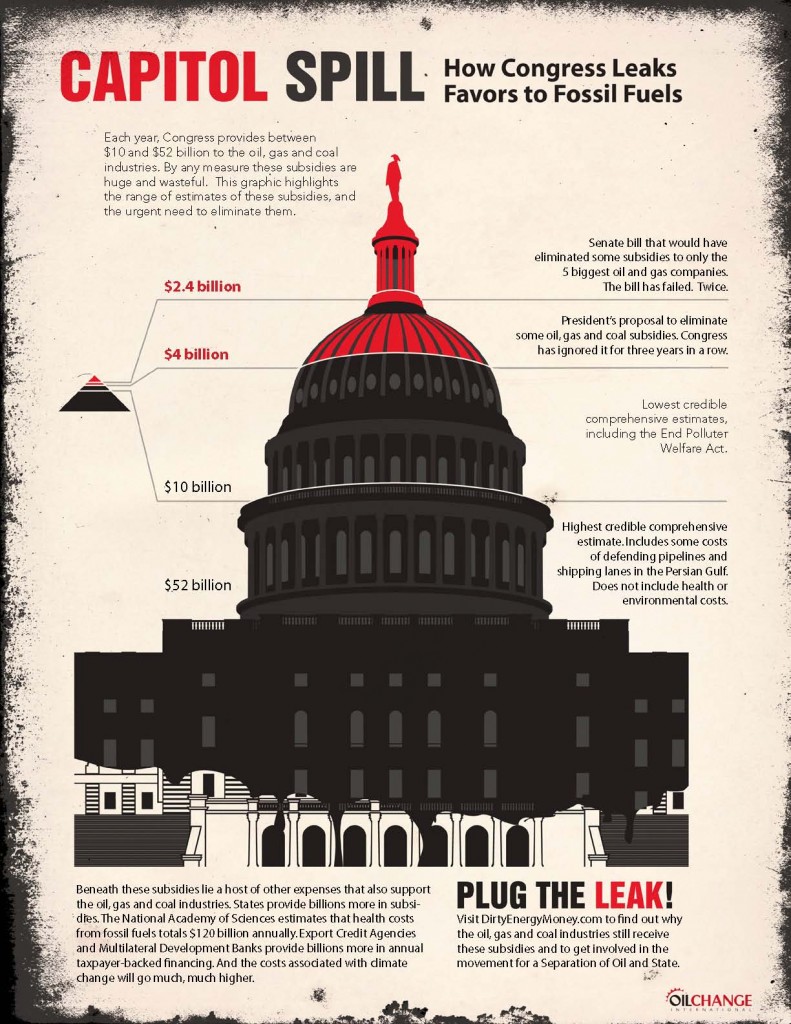 |
| http://priceofoil.org/fossil-fuel-subsidies/ |
The government spends roughly 10 billion dollars a year on subsidies for fossil fuels most of this being gas and coal. Today natural gas is cheaper than gas and is plentiful. But when President Obama tried to remove subsidies he had almost no success. By moving to greener cars which use a cheaper fuel the government can facilitate consumers moving to greener cars as well. In the long run the government can stop subsidizing gas for transportation because there are alternative fuel sources. [Again, the prof notes that gasoline in the US is undertaxed from the perspective of Europe and Japan...]
Blake Grady commented: It shouldn’t be all that surprising that some of these green companies fail. Companies of this sort do fail all the time, as you mentioned. The question instead, as I see it, is whether the occasional failure of the companies is offset by the benefit produced by all of the other companies which don’t fail. [And The Prof would add, whether we look at these failures without paying attention to the successes.]
